Asteria Colored Diamonds

Asteria Colored Diamonds

TechForm

TechForm Platinum Jewelry Casting

Leibish & Co

Thursday, May 17, 2012

Double-Digit Decline in U.S. Gold Jewelry Demand


The high price of gold continues to have a detrimental impact on the worldwide jewelry market as demand in this sector for the precious metal fell by 6 percent, year-over-year, in the first quarter of 2012, the World Gold Council said Thursday. The value of jewelry demand, meanwhile, grew by 14 percent to $28.3 billion.

Gold jewelry demand was weaker in all but six countries and clearly reflects the year-over-year 22 percent increase in the average gold price of gold to 1,690.57, according to the WGC Gold Demand Trend report for the first quarter of 2012.

In the U.S., demand fell 10 percent to 17.6 tons. In addition to the high price of the precious metal, the report blames high gas prices and cautious consumers. In value terms, gold increased by 10 percent to $958.2 million.

In Italy, demand slid 14 percent to 3.5 tons “as the negative economic environment took its toll,” according to the report. In the U.K., demand dropped 4 percent to 3 tons.

India, the world’s largest consumer of gold and gold jewelry, was largely responsible for the worldwide decline, according to the report. An unexpected substantial increase in the import tax on gold and the introduction of an excise duty on gold jewelry resulted in a three-week countrywide strike among jewelers until the government agreed to end the excise duty. A weaker rupee also added to the decline.

Meanwhile, China dominated the jewelry market as demand increased 8 percent to 156.6 tons in the first quarter. China accounted for 30 percent of all demand for the period, making it the largest gold jewelry market for the third consecutive quarter.

Demand in Russia was also robust with a 28 percent increase in the first quarter to 20.4 tons, attributed partly to stock building among the trade. However, the repot notes that “historically low inflation, GDP growth, improving consumer confidence and real wage gold,” contributed greatly to the gains. “Gold remains the most popular metal of choice among Russian jewelry consumers.”

Overall, global gold demand in the first quarter fell by 5 percent to 1,097.6 tons, the WGC reports. “This decrease was largely to be expected given the introduction of import taxes in India and high gold prices,” the report states. “Demand for the quarter was underpinned by increased demand in China, continued central bank purchasing and inflows into exchange-traded funds.”

Gold demand value for the period increased 16 percent to $59.7 billion. Gold demand includes its use in jewelry, technology, investment and official sector institutions (such as world banks).

“China and India have seen continuing economic growth and whilst China’s economy is expected to slow, it will nonetheless surpass the rates of growth in the West,” said Marcus Grubb, managing director, Investment at the World Gold Council. “As we previously forecast it is likely China will become the largest source of demand for gold in 2012.”

Tuesday, May 15, 2012

Tiffany Restructures its U.A.E. Retail Operation

Tiffany & Co. has taken control of its destiny in the United Arab Emirates by restructuring its joint agreement with retailer Damas Jewellery.

Damas, based in the U.A.E., is an international jewelry and watch retailer. Under the new partnership agreement between the two companies, all of operational, merchandising and sales, and marketing management for the five Tiffany & Co. stores in the U.A.E. will be transferred from Damas to Tiffany. Previously, Tiffany sold its merchandise, on a wholesale basis, to Damas which operated the Tiffany & Co. stores.

The move was reportedly related to Damas’ delisting from Nasdaq Dubai after shareholders agreed to a buyout bid from a consortium of private investors.

Under the new joint venture, the new entity will be incorporated in the U.A.E as TCO Damas Associates L.L.C.

“This restructuring of our retail presence in the U.A.E. through this joint venture with Damas allows us, for the first time, to wholly manage Tiffany's operational activities,” said Laurent Cathala, Tiffany's VP of Emerging Markets. “It underscores the importance of the U.A.E. market to our global expansion strategy and highlights our optimism about the long-term growth potential we see throughout the Middle East.”

Tiffany also announced the appointment of Stephane de Palmas as general manager of the new U.A.E. retail operation. The 46-year-old luxury retail veteran will be responsible for the overall management of the Tiffany & Co. stores in Dubai and Abu Dhabi.

Monday, May 14, 2012

Lily Safra’s Jewels for Hope Raises $38 Million for Charity, Sets 2 Records


The highly anticipated auction of “Jewels For Hope: The Collection of Mrs. Lily Safra,” held Monday at Christie's Geneva raised $37.9 million with 100 percent sold by lot and by value, far exceeding its pre-sale estimate. 


The top lot of the sale was a 32.08 carats cushion-shaped Burmese ruby and diamond ring, known as “The Hope Ruby”by Chaumet (pictured above), which sold for $6.7 million, well above its $5 million high estimate. It is a world record price for any ruby sold at auction. 

Tourmaline and diamond flower brooch by JAR sold for more than $1.2 million.

A group of 18 jewels by JAR, the largest ever seen on the market from a single-owner collection, sold 100 percent by lot and by value, totaling more than $11.4 million—the most valuable private-owner collection of JAR jewels ever sold at auction.

“Mrs. Safra received a standing ovation as she walked into the saleroom at the end of the sale to thank every buyer and bidder who contributed to this evening’s great success,” said Rahul Kadakia, head of Christie's Geneva and New York Jewellery Departments.

It was announced prior to the sale that the full proceeds from the auction would benefit 20 charitable institutions. As a result of the sale’s success, The Lily Safra Foundation decided to add 12 additional organizations as beneficiaries.

“From the bottom of my heart, I want to thank everyone who participated in this evening’s success,” Safra said. “I am overjoyed, knowing that so many people in need around the world will benefit.”

The 32 organizations that will benefit from the sale are as follows:

* Agahozo-Shalom Youth Village, Rwanda
* ALEH: Caring for Israel‟s Disabled
* Alfredo J. Monteverde School, Natal, Brazil
* A Window to Tomorrow – A Computer for Every Child, Israel
* Children Action, Geneva, Switzerland
* Claude Pompidou Institute for Alzheimer‟s Disease, Nice, France
* Edmond and Lily Safra Center for Brain Sciences, The Hebrew University of Jerusalem
* Edmond and Lily Safra Children‟s Hospital, Tel Hashomer, Israel
* Edmond J. Safra Family Lodge at the National Institutes of Health (NIH), Bethesda, Maryland
* Elton John AIDS Foundation (worldwide)
* Fight AIDS Monaco
* Henry Street Settlement, New York
* Hope and Homes for Children, Romania
* Hôpitaux Universitaires de Genève
* Imperial College, London: Edmond J. Safra Chair in Neuropsychopharmacology & Edmond J. Safra Chair in Radiochemistry
* Institute for Brain and Spinal Cord Disorders, Pitié-Salpêtrière Hospital, Paris
* Israel Philharmonic Orchestra
* Jordan River Village Camp for seriously ill children
* Keren Shemesh, Israel
* King‟s College, London: Edmond and Lily Safra Parkinson‟s Research Fellowships
* Le ballet de l‟Opéra national de Paris
* Les Restaurants du Coeur, France
* Michael J. Fox Foundation for Parkinson‟s Research, USA
* Museum of Jewish Heritage, New York
* New York University, Parkinson and Movement Disorders Center
* Royal Opera House, London
* UNICEF, USA
* Université Joseph Fourier, Institut des Neurosciences, Bâtiment Edmond J. Safra & Institut Clinatec, Centre de Recherche Edmond J. Safra, Grenoble, France
* University of Toronto and Toronto Western Hospital, Canada: Edmond J. Safra Program in Parkinson‟s Disease (Dr. Anthony Lang & Dr. Andres Lozano)
* Water Treatment Program, Amélia Rodrigues (Bahia), Brazil
* Yad Vashem International School, Israel
* Yahad-In Unum, France

Royal Asscher to Open Pop-Up Store Thursday in Las Vegas

Royal Asscher pop-up store will be in the Shoppes at the Palazzo.

Pop-up stores are now fairly common occurrences. However, in the jewelry industry trends come a bit slower than most other fashion and retail related industries. Royal Asscher Diamond Company, the 158-year-old company known for cutting some of the world’s largest and most valuable diamonds, is now being managed by Lita and Mike Asscher, the sixth generation heirs to the venerable company. It would make sense that this brother and sister team, both in their early 30s, would be leading the way for the industry.

Royal Asscher will open its pop-up store in Las Vegas from May 17 till June 4. The 1,200-square-foot store will be in the Shoppes at the Palazzo adjacent to the “Cut” Steakhouse. Hours of operation  will be Sunday – Thursday from 10:00 a.m. till 11:00 p.m. and Friday – Saturday from 10:00 a.m. till midnight. 


The “one-off” experience will include the launch of new lines of its Shining Star collection. In addition, visitors will have the opportunity to pose with a diamond tiara (pictured above) designed for the Royal Wedding of Catherine Middleton, now Duchess of Cambridge, and Prince William. The 85-carat tiara designed by Reena Ahluwalia, a Toronto-based jewelry designer, was one of the few considered for her wedding day, Royal Asscher says. It’s a privilege usually exclusively reserved for private clientele of Royal Asscher spending $250,000 and above. The general public will be able to pose with the tiara from noon till 2 p.m.

The dates are significant because it also coincides with Las Vegas Jewelry Week, a series of jewelry industry tradeshows that run roughly from May 28 till June 4.

Thursday, May 10, 2012

Affluent Households Will Increase Luxury Spending by 3%

Jim Taylor
PALM BEACH, Florida — Overall spending on luxury goods and services will rise by 3 percent in 2012 among those the top 10 percent of American households, led by the top 1 percent who will spend 4 to 5 percent more than the prior year, according to a recently released survey. This includes a slight increase in the sales of luxury jewelry and timepieces.

“It’s a very healthy increase and will likely be sustained well into the next year,” Jim Taylor of the Harrison Group said Monday at the American Express Publishing Luxury Summit, held at The Breakers.

For the sixth year, Taylor gave his entertaining talk on the state of the top 10 percent of U.S. households based on income in the Survey of Affluence and Wealth in America report. According to the survey, there are approximately 12 million households in 2012 with at least $100,000 in discretionary income that make up the top 10 percent. The study of 1,268 affluent and wealthy consumers tracks the attitudes, lifestyles, luxury category spending patterns and financial services participation in this demographic. Among its findings:

* The total discretionary luxury consumption market for 2012 will be approximately $375 billion and nearly two thirds of all luxury spending will be consumed the top 12 million families.

* The wealthiest consumers in the U.S. are sitting on approximately $6 trillion in savings that could balloon to $12 trillion by 2014, Taylor said during a sunrise meeting with journalists Tuesday. If the holders of these savings start spending, it could bring about “A capital boon in America the likes of which we’ve never seen.” On average, families in the study save 23 percent of their income, which increases to 34 percent among the one percent.

* The most likely investment for all of this money is real estate beginning in 2014 as it is one of the few places where there are still deals available. “A real estate boom is around the corner because there is nowhere else to put the money,” Taylor told the luxury summit attendees Monday.

* What’s stopping the wealthy from moving their savings is their pessimism about the economy. Among those surveyed, 78 percent believe the U.S. is in a recession and 52 percent believe that it will last for a least another year. “What’s driving these people nuts is the pronouncement that everything is okay,” he said.

* A secondary reason why the wealthiest Americans are saving is because they feel their success is under siege from the Occupy Wall Street movement and the political debate over the fairness of the increasing gap between the wealthy and the middle class. About 20 percent of consumers with discretionary incomes at $250,000 and about 25 percent of the one percent are worried about being disparaged for being financially successful. “It is clear that American entrepreneurs and successful people are nervous about the break out of an extraordinary kind of antagonistic class warfare as the election season unfolds,” Taylor said.

* Surprisingly, 75 percent of those surveyed favor a significant tax increase on income but not on their assets, Taylor said.

* Philanthropic spending is closer to home and family than it has been in the past: church, school, healthcare. “There’s a growing abandonment of environmental causes and social causes,” Taylor said. “We are seeing an inclination not to share.”

This complex picture of wealthy households affects how these households view luxury goods and services.

For example, the study is documenting a shift away from value-driven spending with more than 30 percent of respondents skeptical of the value of consumption itself. The survey has defined this as “The Worth Movement.”

“These families can be heard to say about a trip, a dress, an automobile, a piece of jewelry, or even an investment, ‘I know I spent more than I had to but it was worth it,” said Cara David, Senior VP at American Express Publishing, which co-produced the report.

Fundamental worth oriented shoppers (about 19 percent of respondents) are characterized by the following:

* A preference for stores that are elegant (78 percent);
* A desire for the experience of purchasing to be as pleasant as the experience of owning (83%);
* A greater likelihood of having close relationships with a select group of salespersons (36 percent); and
* A belief that it is worth paying more for the very best quality automobiles (76 percent), hotels (73 percent) and jewelry (63 percent).

“What people want is a company that shares their value system and this value system is expressed in the transaction, design and advertising and to the extent that it remains consistent is fluid over time,” Taylor said. “What we’re advocating is you got to find out what your brand means to you.… It’s not enough just to be different.”

Saturday, May 5, 2012

A Nib is Born

Axel Nier, technical setter of Montblanc’s Nib Manufacturing facility, holds a 13-pound reel of gold. This is how nibs begin their life at Montblanc. Photo credit: Anthony DeMarco

HAMBURG, Germany — How many people does it take to make a nib? At Montblanc it takes about 50 who work through an approximate 35-step process. That’s a lot of work for such a small object.

Just to be clear, what I’m talking about is the part of the dip pen or fountain pen that comes into contact with the writing surface to deposit ink.

The process combines old hand-crafted techniques with the precision of modern machinery. It’s an assembly line system but the human touch throughout the process ensures that each nib gets personal attention. Each nib goes through the same process but, yet, each is unique, explains Axel Nier, technical setter of Montblanc’s Nib Manufacturing facility, who took me on a tour of the clean, well-organized and productive facility in Montblanc’s headquarters.

“We really have hand work that’s over 100 years old so that each nib that leaves Montblanc is hand-grinded so there’s really a soul in the fountain pen,” Nier said. “Everything you see here is really the heart of the fountain pen.”

A brief overview of the process follows:

Photo credit: Anthony DeMarco

A nib begins life as a 13-pound spool that looks similar to a reel of motion picture film (top picture). The flat surface moves through a machine that stamps the initial outline, breather holes and stamp of the nib. One side is thicker, which is the writing side of the nib while the thin end goes into the ink feeder. Only 40 percent of the gold is used. The remaining 60 percent is recycled.


The individual pieces move to a press to get its convex shape—15 to 20 pounds of pressure is used. They are then checked by hand to ensure that the shape is exact.

And admittedly blurry image of tiny iridium balls that will be attached to the gold nibs. Photo credit: Anthony DeMarco

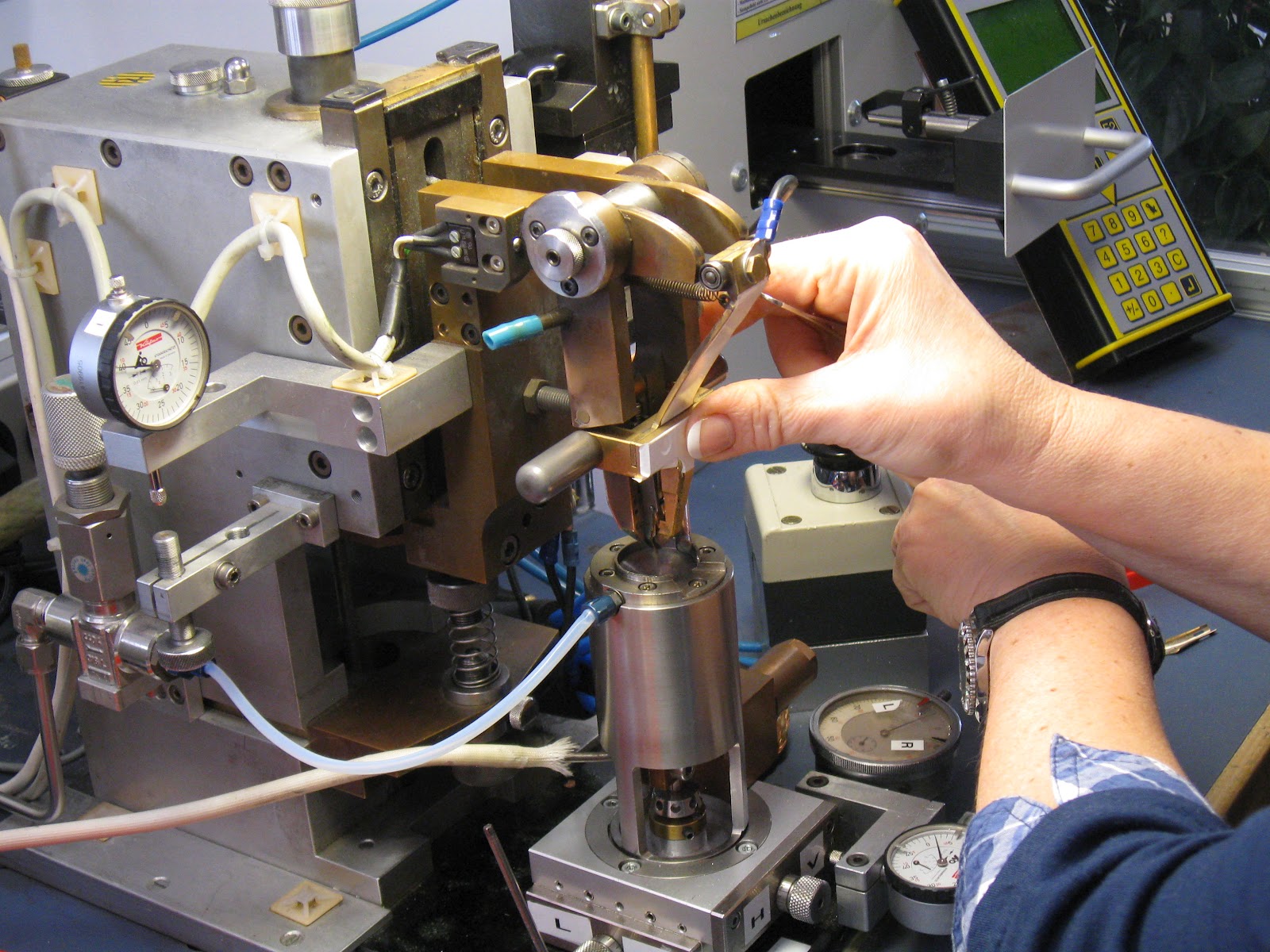
The electrical welder that welds the iridium ball onto the gold surface. Photo credit: Anthony DeMarco

A tiny iridium ball is then quick-welded onto each nib with a machine that creates a near oxygen-free environment. A spark of a flame does the job of fastening the hard iridium ball onto the soft gold. It takes a split second. The roundness and hardness of the iridium ensures that the nib will be able to glide across paper and last a long time.

The diamond blade slices the nib into two sections. Photo credit: Anthony DeMarco

A sliver of a cut is made through the iridium ball and gold to create two rectangular wings. Iridium is one of the hardest surfaces on the planet while gold is a soft metal. It takes a special blade to cut the hard iridium point and the gold quickly at the same time. A thin diamond blade is used. It’s so thin that it literally crumbles and tears if not handled delicately.

Photo credit: Montblanb

Grinding of the nib is next, which smooths the edges of the gold around the iridium point.
 
Photo credit: Anthony DeMarco

Next comes the mask. Some of the writing instruments use two colors of gold. Rhodium is used to create white gold so those nibs get a rhodium bath. The mask is placed over the areas that will not receive the coating.

Photo credit: Montblonc

The last step is to assemble the nib to the feeder. Then the nibs are tested by hand. One person spends her day writing eights and other lines to ensure the ink flows properly and the pen handles well. Invisible ink is used so it doesn’t appear to the customer it has been tested.

And the final result.

Photo Credit: Montblonc

Below is video from Montblanc video that presents a stylized but accurate version of the nib manufacturing process as well as the work of artisan atelier that I wrote about Friday.

Helzberg Diamonds Sponsors Kentucky Derby Jockey

Jockey Javier Castellano in his Helzberg Diamonds racing suit. Photo credit: Helzberg Diamonds


Jewelry retailer Helzberg Diamonds is hoping it picked the winner in today’s Kentucky Derby through its sponsorship of jockey, Javier Castellano, who will ride Gemologist.

Castellano and Gemologist are currently the favorite at 9-1 odds in the 21-horse field.

Castellano has been involved in the North Kansas City, Mo.-based company’s promotion for the Derby through personal appearances, interviews made available on the retailer’s Facebook and Twitter pages and this video on the Helzberg Diamonds website.


The Berkshire Hathaway-owned jewelry retailer has also has been using the Derby tie-in for several cross-promotional activities that include its “I am Loved” Mother’s Day button, a fashionable jewelry guide for women to wear on Kentucky Derby day and a “Derby things we love” Pinterest page.

Heading into the Derby, Castellano and Gemologist have won four straight races, including the Grade 1 Wood Memorial. Castellano is currently the leading jockey in major wins and earnings. He will be riding Gemologist in an effort to join other undefeated Kentucky Derby winners. A total of seven horses have won the Derby undefeated and Gemologist will be the 23rd to attempt this feat since 1900.

In 2011, Castellano finished as one of the top five jockeys in the nation, with 11 Grade 1 victories, more than any other rider that year.

The Kentucky Derby post time is scheduled for 6:24 p.m. The race will be televised on NBC.