Asteria Colored Diamonds

Asteria Colored Diamonds

TechForm

TechForm Platinum Jewelry Casting

Leibish & Co

Showing posts with label Verdura. Show all posts

Wednesday, June 28, 2017

The High Jewels To See At 2017 Masterpiece London

A scene from the 2016 edition of Masterpiece London

All of the top names from the past and present of the high jewelry world will be there, such as Fabergé, Van Cleef & Arpels, Verdura, Belperron, Wallace Chan and Hemmerle. Other familiar names for avid jewelry collectors will be present as well, including Gustave Baugrand, Andrew Grima and Raymond Yard. There will be jewels from all periods and names that will be new to some of us as well.

The eighth edition of Masterpiece London opens to the public Thursday and will run till July 5. It’s an art fair first but the amount of quality jewels (old and new) on display is impressive. For the first time I will be attending the event although I will miss the today’s (Wednesday) preview, arguably the best time to go.

What follows is a preview of some of the jewels that will on display:


It appears that Van Cleef & Arpels will be bringing its Automate Fée Ondine to Masterpiece London, the bejeweled automaton that was the showstopper at the January SIHH 2017 luxury watch fair. The table-sized “jewel” consists of engraved and enameled silver strips, white, pink and yellow gold, diamonds, blue and colored sapphires, aquamarine, plique-à-jour enamel, silver, spessartite garnets, white opal, onyx, Mystery Set rubies and ebony veneer.


A diamond and natural pearl bracelet by Boghossian.


The "Bliss and Peace" necklace by Wallace Chan, which uses an imperial snuff bottle from the Daoguang period (1821-1850) of Qing dynasty.


From London dealer, Hancocks, an Egyptian gold scarab and multi-gem bead necklace by Marcus & Co., circa 1905.


Earrings crafted out of emeralds, silver and white gold, 2016, by Hemmerle.


From Monaco jewelry dealer, Véronique Bamps, Van Cleef & Arpels “Ludo Hexagone” clip brooches and bracelet made of 18k gold and diamonds, circa 1935.


From London dealer, Sandra Cronan, an emerald-shaped aquamarine gem on a clip by Raymond Yard with four tapered slivers of opal on two diagonally opposing corners with two rows of diamond running up each side, circa 1933.


From the jointly owned jewelry brands, Verdura and Belperron, the Verdura Raja ring with a Ceylon sapphire center stone surrounded by turquoise and diamonds.


From London dealer, S.J. Phillips, a 19th century pink topaz, diamond and emerald insect brooch, circa 1890.


From London dealer, Wartski, an enamel and gem-set neo-Egyptian brooch by Gustave Baugrand.


The Underwater Ring by London jeweler, Theo Fennell.


From London jeweler, Chatila, an 8.18-carat pear shaped fancy purplish pink diamond on a ring flanked by two white diamonds.


From London dealer, Didier, an 18k gold ring in the form of a self-portrait of the artist, Marisol Escobar, her hair tied in coils around her ears, and set with ruby eyes. Number 32 from an edition of 100, circa 1970.


From London jewelry brand, Grima, yellow gold drop earrings set with golden diamonds and drop-shaped garnets by Jojo Grima, 2006.


From London dealer, Symbolic & Chase, a cultured pearl and platinum ring by Jean Despres.


From New York dealer, A La Vieille Russie, a miniature fish-form egg pendant by Fabergé, using wood and gem-set gold.

Please join me on the Jewelry News Network Facebook Page, on Twitter @JewelryNewsNet, the Forbes website and on Instagram @JewelryNewsNetwork

Tuesday, March 21, 2017

Inside The Haute Joaillerie Section Of TEFAF Maastricht

Wallace Chan introduces a group tour at TEFAF to his dreamlike world

From the dreamlike world of Wallace Chan to the precise jewelry art of Hemmerle, the high jewelry area of TEFAF Maastricht, though small, contained a wealth of variety. And from the moment the show started, the jewelry lovers who came to the small out-of-the-way city of Maastricht, Netherlands, to attend The European Fine Arts Fair (more commonly known as TEFAF) started buying.

The bamboo framed exhibition space of Hemmerle

On the March 9 preview day, moments after the doors opened at the Maastricht Exhibition and Congress Centre (MECC) for the VIP buyers, I was inside the bamboo framed Hemmerle exhibition space when a woman came in, tried on a pair of one-of-a-kind gold earrings made with a wax process that created gold strands in a basket-like weave. She walked back and forth briefly looking in the mirror and bought them on the spot. I took a picture before they were whisked away.

Hemmerle earrings that sold within minutes after TEFAF opened. Old mine cut diamonds appear to be floating inside gold strands that looked as if they were weaved

“The fair is our first public presentation each year and we are glad to report strong consistent sales from the first 10 minutes of day 1,” said Christian Hemmerle at the close of the 10-day fair.

These earrings from Wallace Chan have everything: wood and titanium; emeralds, sapphires and diamonds; shadows and light 

Before I had a chance to enter Wallace Chan’s booth, the famed Hong Kong jewelry artist sold one of his elaborate titanium and colored-gem brooches. Chan, who always is in a good frame of mind, was particularly happy at this year’s show, saying he loves seeing old friends here.

Belperron diamond and ruby necklace. the center stone is a
rare star ruby

Meanwhile, Ward and Nico Landrigan, the father and son team that own the mid-20th Century brands, Verdura and Belperron, also were in good spirits after selling a circa 1960 yellow gold and diamond Verdura brooch. 

A Verdura bird clutching a natural pearl with diamond and emerald wings.

I was trying to have lunch with the public relations representative of Hancocks of London and couple of other jewelry writers (I said trying because the restaurant was so full they stopped serving food, giving an idea of how crowded it was), when the PR rep looked at her phone and suddenly said, “I have to go the tiara’s been sold.” The “tiara” is the Spencer family Edwardian diamond tiara. It was given to Lady Delia Spencer, great aunt to Princess Diana, by her father the 6th Earl Spencer, on her wedding day in 1914. Set with more than 800 old cut diamonds, estimated to weigh a total of 48 carats, the tiara can be transformed into a choker necklace and bracelet.

The Spencer Tiara sold by Hancocks of London

Very few of the prices of these sales were revealed but these are not typical impulse purchases. These are items that sell from tens of thousands of dollars to the stratosphere. One price that was revealed was the “Nef” necklace, from German high jeweler Otto Jakob that sold for €142,000 ($153,580).

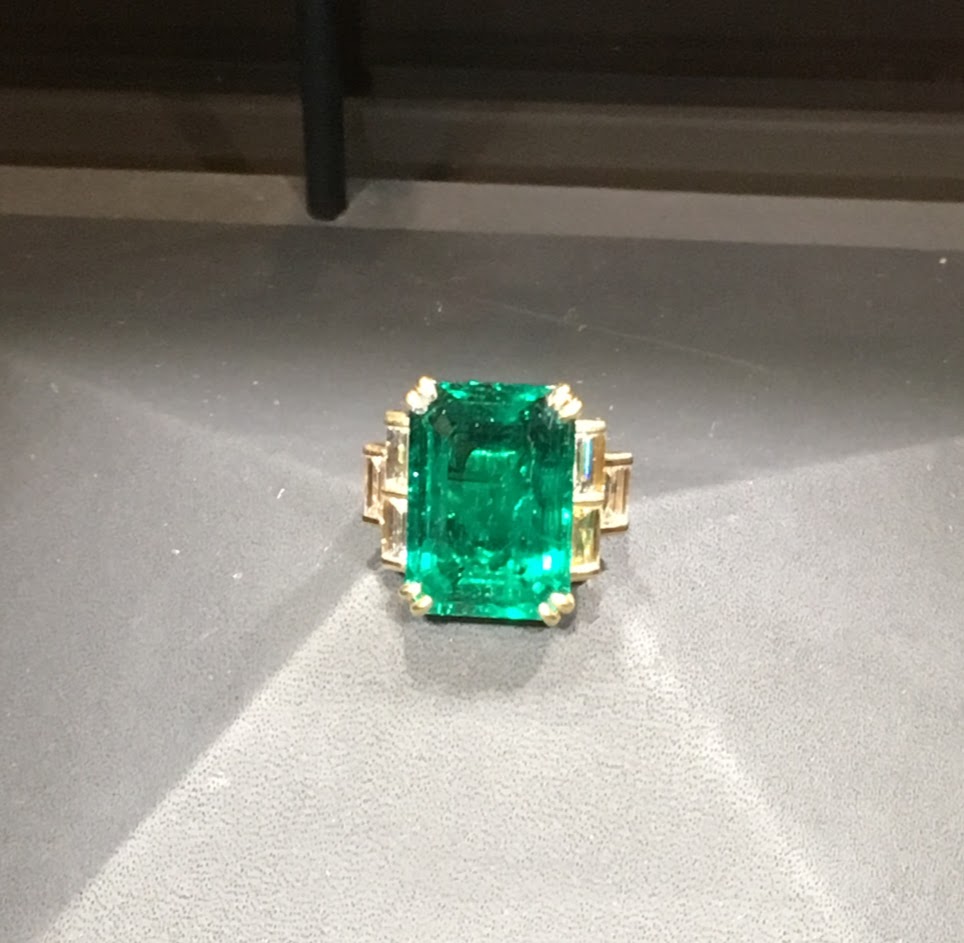
An emerald ring by Reza

I had to cancel an appointment with Olivier Reza, the head of the Parisian jewelry brand, Reza, because the jeweler’s booth was too crowded with customers. 

Van Cleef & Arpels transformable necklace and earrings, 1959, made of emeralds, yellow and blue sapphires, and diamonds

Van Cleef & Arpels and Chopard, the two largest brands in the high jewelry section, brought combinations of vintage and new jewels. 

Chopard L.U.C. XPS made with Fairmined gold

Opening day, March 10, was more manageable but still very crowded. I spoke to one woman lived about an hour away in Germany who said it was the first time she attended an art fair. She came to see Wallace Chan’s exhibit and was so amazed and astounded by what he presented that she returned to the booth seven times. She purchased Chan’s book “Dream Light Water” and had the artist sign it. 

Honcocks of London's booth

Final numbers released by TEFAF show that the fair was very active with more than 71,000 visitors, from more than 60 nations visiting the 275 dealers during the 10-day fair. This includes approximately 200 museums. 

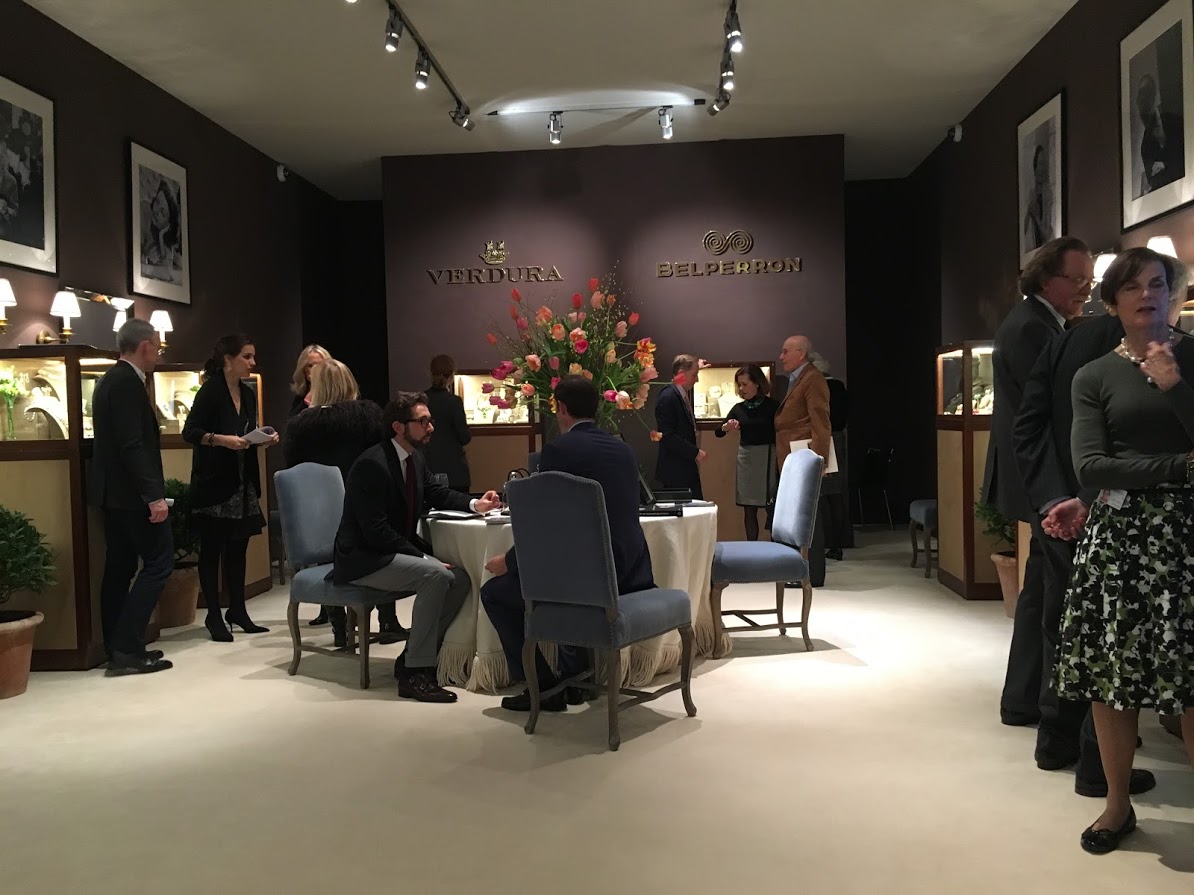
The bust Verdura and Belperron booth

High jewelry amounts to one of nine art categories that TEFAF offers. The others are Antiques, Classical Antiquities, Curated, Design, Modern, Paintings, Paper, and Showcase. Trade fair officials were touting some of the larger sales. Among them:


* Antiquariat Bibermuehle AG Heribert Tenschert sold a 12-volume series of books, Historia naturalis, originally created for Emperor Rudolph II of Habsburg, 1596-1610, to a private collector. The series came to market for the first time in 25 year and was sold for a seven-figure sum. 


* Tomasso Brothers Fine Art sold an important work by the Renaissance master Giambologna (1529-1608). It is the earliest recorded work by the artist and the only surviving sculpture that he carved in wood. The carving was acquired by a new client, described as an important European private collector, and was priced at about €1.5million ($1.62 million). 


* Antiques dealer Les Enluminures sold the 1,000-year-old Gospel Book of Liesborn Abbey in Westphalia to the German government for more than $3 million. 

* Ben Janssens Oriental Art Ltd said he sold more than 70 items by the mid-point of the fair, including a set of four iron paintings, Tiehua, China, Qing dynasty, 18th Century, which had an asking price of €50,000 ($54,000). 

Rossi & Rossi sold a colorful Tibetan cloth painting, “Sabzang Pakpa Zhonnu Lodro” (1358-1412/24) for approximately $400,000. 


The artwork at the entrance of TEFAF Maastricht

* Emanuel von Baeyer sold 12 works to private collectors with further works on reserve with museums. A key work that sold was The Signboard of the Gersaint Gallery, 1732, the very rare engraving after Jean-Antoine Watteau (1684-1721). 


* James Butterwick sold more than €180,000 worth of works, including Still Life with Carafe and Glass on a Mirror, 1915 by Alexander Bogomazov (1880-1930) to a private Swiss collector.

* Landau Fine Art, Inc. had one of the biggest sales of the Fair, selling the monumental work “Henri Michaux acteur Japonais,” 1946 by Jean Dubuffet (1901-1985), which had an asking price of $6.5 million, to a private collector. 

* Bernard de Grunne sold 11 Sepik works from Papua New Guinea to one private collector. The pieces ranged from €80,000 to €250,000 ($86,500 to $270,000). 

* Classical antiquities sold at Charles Ede included a statuette of the “Apis bull, Late Dynastic Period,” 26th Dynasty, circa 664-525 BC, which had an asking price of £65,000 ($81,100), as well as a Graeco-Roman large footed basin, circa 2nd-century BC, with an asking price of £160,000 ($199,650).  

The talk prior to the fair was that art and jewelry sales are down. This is either an exception or the beginning of a new dawn for both the art and jewelry markets. 

Please join me on the Jewelry News Network Facebook Page, on Twitter @JewelryNewsNet, the Forbes website and on Instagram @JewelryNewsNetwork

Friday, June 10, 2016

Verdura Cuff For Coco Chanel Sells For $100,000 At Christie’s


One of Fulco di Verdura’s earliest jewelry works for the famed fashion designer, Coco Chanel, was sold at Christie’s New York Magnificent Jewels sale Thursday. The buyer was the Verdura brand.

The cuff, made circa 1935, was part of the the collection of Gabrielle “Coco” Chanel. The New York-based jewelry brand, Verdura, said it purchased the bangle for $100,000, nearly three times its high estimate of $35,000. 

The cream colored enamel hinged bangle is set at the top with cabochon red and green simulated gemstones, accented on either side by a line of graduated caliber-cut green simulated gemstones, to the rectangular-cut blue simulated gemstones. The silver jewel was unsigned. However, the gem “is accompanied by a letter from Verdura confirming that in their opinion, the cuff bracelet was made from a design by Duke Fulco di Verdura for his friend Gabrielle (Coco) Chanel.”

Verdura said in a statement that the newly acquired cuff be part of the Verdura Museum Collection. It will join Chanel’s original “Maltese Cross” Cuffs, circa 1930, made by the influential jewelry designer for Coco Chanel, which are already part of the collection.

“It’s an early and important example of Duke Fulco di Verdura’s design influence on one of the 20th Century’s most iconic couturiers,” said Nico Landrigan, president of Verdura. “Coco Chanel looked to Fulco for great design in jewelry and this is an important example of their collaboration.”

The brand Verdura, purchased the Verdura business, including all of the artist’s drawings, in 1985 and has since been collecting and selling original Verdura pieces and creating and selling new pieces based on the original drawings under the Verdura name. 

Please join me on the Jewelry News Network Facebook Page, on Twitter @JewelryNewsNet, the Forbes website and on Instagram @JewelryNewsNetwork

Sunday, October 11, 2015

The Belperron Jewelry Revival Begins

Vintage Bamboo Necklace with Detachable Brooches in diamonds, platinum and gold

Suzanne Belperron (1900 – 1983) is considered by many to be one of the most influential jewelry designers of the 20th Century. Her complex, sculptural pieces—personally created for royalty, world-class entertainers and other notable persons from the 1930s to the 1970s—are highly sought among collectors throughout the world, particularly at auction. 

Now for the first time since her retirement in the 1970s new pieces designed by the French artist are available for purchase. In addition, there’s a new showroom in New York to view and purchase both the new collection of posthumous pieces and vintage original items. 

Wai Gu Necklace in nephrite jade and gold

The father and son team of Ward and Nico Landrigan are behind this rebirth of the artist and her brand. It’s something they’ve done before. In 1985, Ward, the former head of Sotheby’s US jewelry department, purchased the remains of the Verdura brand, founded by its creative namesake, Fulco di Verdura (1898 -1978), and with his son returned it to its original glory.

The Landrigans unveiled the Belperron showroom on Thursday. The private space is adjacent to the Verdura showroom, connected by a sliding door. Both are on the 12th floor of an office building on 5th Avenue in New York. 

Inside the Belperron salon during its public unveiling. Photo credit: Anthony DeMarco 

In a brief conversation with Ward Landrigan during the showroom opening, he said the formula is the same as with Verdura. Find an undervalued jewelry brand with an impeccable heritage and a famous namesake, acquire it for the right price, and recreate the jewels and heritage. It sounds easy enough but it requires (among other things) great negotiating skills, strict budgeting (particularly for a small business owner) and lots of patience.

After nine years of negotiations with several persons who were unsuccessful in their own attempt to revive the brand, the Landrigans acquired the rights of Belperron in 1999 (or 1998 depending on who you consult) and spent another 16 years bringing the rebirth of the brand to its fruition. As with Verdura, the purchase included artifacts as well as thousands of original drawings by Suzanne Belperron. 

Vintage Godrons Heart Brooch in chalcedony, sapphire and diamonds

With the drawings the Landrigans (as they did with Verdura) began recreating Belperron jewelry using artisans specialized in specific jewelry making techniques, including Parisian workshops with a direct family line to Belperron’s original master craftsmen. 

Over the years, the Landrigans also purchased as much Belperron jewelry as they could through the auction market and private sales to augment the new pieces.

Vintage Torsade Necklace in gold and diamonds

The artistic jewels of Suzanne Belperron reflect a number of different influences. She first became known for her Art deco creations of the 1930s but eventually broke away from the rigid geometric aesthetic and began making jewels with Egyptian, Asian, African and Oceania influences. She was inspired by nature and created shapes based on flora and fauna, on land and below the sea. She was known for her elaborate color combinations and for setting precious stones in semiprecious materials. She also preferred working with 22k gold, despite its softness, because of its color. 

“She was a sculptress, with a gift for divining beautiful shapes,” says Nico Landrigan, who serves as Belperron president. “Belperron had an uncanny sense of texture, color and scale; she understood when to hold a line through the most torturous spiral and when to break it with the rogue placement of an errant gemstone.”

Vintage Tonneau Brooch in chalcedony, diamonds and lacquer

Belperron designed pieces specifically for each individual and hand-delivered them upon their completion. 

She did all of her business by appointment in her private salon in Paris. This leads to the final stage of recreating the Belperron brand.

The Landrigans and their team built a space inspired by the interior of Belperron’s salon. 

Scroll Clasp Necklace with Detachable Vintage Brooch in emeralds an diamonds

This is the third time I’ve seen this space. The first time it was under construction site preparing for the exhibition, “The Power of Style: Verdura at 75” in June 2014. The second time I saw it was at the end of 2014 when the exhibition space was completed. 

Now it has been converted into four comfortable rooms that include a library and a drawing room that captures the aesthetic of a 1930s Parisian apartment. The space features black lacquered trim, sable-colored cases, marble fireplaces and chalcedony blue walls. Couches and fabric-lined chairs of various colors from white to purple are among the antique or antique-styled furnishings in the space. 

Coquillage Earclips in diamonds, platinum and lacquer

The salon’s design came from Belperron’s archive of original gouache paintings, tracings and other archival materials, says project architect, Daniel Romualdez. “I wanted to create an environment that spoke to the elegance and glamour of this spectacular Fifth Avenue location while still evoking the intimate and private world of Suzanne Belperron in Paris of the 1930s.”

The jewelry collection on display includes recreated pieces from the archival drawings and the vintage items purchased by the Landrigans. They are for sale. There also are privately owned Belperron pieces on display that are not for sale. 

Spire pendant Earrings in gold

Among the highlights I saw were the Vintage Bamboo Necklace in diamond, platinum, gold and silver. The two leafy ends of the bamboo necklaces are detachable and can be worn as brooches. A Vintage Tonneau Brooch has the smoky glass appearance of Chalcedony, which seems to be a favorite material for the artist, studded with round diamonds and edges of black enamel. 

Like several of the great jewelry designers of the 20th Century, Belperron found artistic uses for many materials. She was unafraid to use jade as shown by a bold gold necklace lined with rings of nephrite jade. The Wave collection of cuffs and stackable bracelets are as contemporary today as when they were when she first created the design. 

Vintage Roof Cuff in rock crystal, emerald and diamonds

There’s at least one significant way the Belperron brand differs from Verdura. When the Verdura brand was released the Landrigans made a decision to augment its vintage jewels and one-of-a-kind and limited edition recreations, with more affordable recreations. For the first Belperron collection the lowest priced piece item I saw was $13,500, with many pieces well into six figures.

Please join me on the Jewelry News Network Facebook Page, on Twitter @JewelryNewsNet and on the Forbes website

Cambodian Cuff in Smoky Quartz

Tuesday, October 14, 2014

'The Power of Style: Verdura at 75' Opens To The Public

The Laurel Tiara was commissioned for Betsey Whitney and worn during the ceremony marking the appointment of her husband, John Hay Whitney, as UK Ambassador.

It’s rare that a retailer and jewelry design firm can put together a museum-quality exhibition as encompassing as the “The Power of Style: Verdura at 75.”

Original Coco Chanel Maltese Cross Cuffs 

The showcase not only celebrates the 75th anniversary of the Verdura brand, but more importantly it serves as a retrospective of the brand’s founder and namesake, Fulco di Verdura, whose work spanned five decades. The exhibition contains 216 pieces of Verdura jewelry in a museum quality space adjacent to the company’s Fifth Avenue flagship location. 

In the foreground is a bracelet worn by Greta Garbo on screen and in the background is a look at the Fulcon di Verdura and Coco Chanel photograph with the Maltese Cross cuff. 

“It started out being 150 pieces but as word got out that we were going to do a museum quality exhibition, people got excited about it and started opening their jewel boxes,” said Ward Landrigan, who purchased Verdura in 1985. “For people who wear this jewelry a lot, it’s a long time to be without it.”

Jewelry and photographs of famous women wearing verdura pieces, including Babe Paley, described as Verdura's muse, in the background.

The exhibition opened to the public Tuesday and will run till December 23 at 745 Fifth Avenue, 12th floor. Reservations can be made by following this link

A portion of the exhibition space is dedicated to ledgers that recorded sales and jewelry drawings by Fulco di Verdura.

Even though the business is a retailer and a creator of jewelry based on Verdura’s original designs, the company managed to put together a proper representation of the designer, his work and a glimpse into the man, known for his well-connected friends and for being the life of the party. At least part of the reason had to be because the exhibition was curated by international fashion designer, Carolina Herrera, and her husband Reinaldo, who were personal friends of Verdura. 

Bejeweled elephant

The items are arranged either by period, theme or style in large wall cases, where the jewelry appears to be floating, or in standalone cases for special pieces, such as the Chanel bracelets or the Whitney tiara. It is a well lit space from the inside and outside light colored walls and well-placed partitions give the space breadth and depth. 

Snail brooches
“First we get all this jewelry and then you try to make sense of what relates to what and how,” Landrigan says. “Luckily, because he did so many things that were of interest, we didn’t have any trouble with that.”

Kunzite Wing Brooch

Along with the pieces are jewelry sketches, photographs of Verdura, who died in 1978, miniature paintings by Verdura, and photographs of the many celebrities, aristocrats, politicians and business people (men and women) who wore his jewelry or collected his art objects. All of the business transactions, no matter how noteworthy the client, were recorded on ledgers. One ledger and photographs of others are on display, revealing some of the famous clientele.

Tea Rose brooch

All of the pieces have either been loaned to the exhibition by the owners or their estates or are part of Landrigan's personal collection. He stresses that none of the items are for sale. Those who donated their pieces include Brooke Shields, Sofia Coppola, Whoopi Goldberg and philanthropist Mercedes Bass. 

Fulco di Verdura and Coco Chanel. Verdura designed the Maltese Cross Cuff for Coco Chanel, which became an iconic fashion symblol for Coco, for Chanel and for Verdura. 

One of the standouts is the Chanel Maltese Cross Cuffs worn by Verdura’s personal friend and collaborator, Coco Chanel. These became her signature cuffs and were recreated as costume jewelry and sold by Chanel. Landrigan explains that people assumed Verdura made costume jewelry but he didn’t. He made jewelry for Coco Chanel who had them re-made as costume pieces. 

Greta Garbo wears Verdura gold bracelet in 1941 photograph by Clarence Sinclair Bull

Other pieces of note are a yellow gold bracelet worn by Greta Garbo on screen (one of many Verdura pieces worn in movies) and the Laurel tiara, commissioned for Betsey Whitney and worn for the occasion of her husband, John Hay Whitney, being appointed as UK Ambassador.

Blue Diamond Ring

One of the things about Verdura’s work is that he was a true bespoke jeweler, making one-of-a-kind pieces based on the personal preference of a client or a specific occasion. Just about every piece of jewelry and object on display has a unique story. There are many more examples of Fulco di Verdura’s creativity and imagination and many more stories in the exhibition. 

Verdura owner Ward Landrigan in the reflection of a display case that represents five decades of jewelry created by Fulco di Verdura. Behind Landrigan is a photograph of Verdura. Photo credit: Anthony DeMarco

Please join me on the Jewelry News Network Facebook Page, on Twitter @JewelryNewsNet and on the Forbes website.