Asteria Colored Diamonds

Asteria Colored Diamonds

TechForm

TechForm Platinum Jewelry Casting

Leibish & Co

Showing posts with label Wallace Chan. Show all posts

Wednesday, June 28, 2017

The High Jewels To See At 2017 Masterpiece London

A scene from the 2016 edition of Masterpiece London

All of the top names from the past and present of the high jewelry world will be there, such as Fabergé, Van Cleef & Arpels, Verdura, Belperron, Wallace Chan and Hemmerle. Other familiar names for avid jewelry collectors will be present as well, including Gustave Baugrand, Andrew Grima and Raymond Yard. There will be jewels from all periods and names that will be new to some of us as well.

The eighth edition of Masterpiece London opens to the public Thursday and will run till July 5. It’s an art fair first but the amount of quality jewels (old and new) on display is impressive. For the first time I will be attending the event although I will miss the today’s (Wednesday) preview, arguably the best time to go.

What follows is a preview of some of the jewels that will on display:


It appears that Van Cleef & Arpels will be bringing its Automate Fée Ondine to Masterpiece London, the bejeweled automaton that was the showstopper at the January SIHH 2017 luxury watch fair. The table-sized “jewel” consists of engraved and enameled silver strips, white, pink and yellow gold, diamonds, blue and colored sapphires, aquamarine, plique-à-jour enamel, silver, spessartite garnets, white opal, onyx, Mystery Set rubies and ebony veneer.


A diamond and natural pearl bracelet by Boghossian.


The "Bliss and Peace" necklace by Wallace Chan, which uses an imperial snuff bottle from the Daoguang period (1821-1850) of Qing dynasty.


From London dealer, Hancocks, an Egyptian gold scarab and multi-gem bead necklace by Marcus & Co., circa 1905.


Earrings crafted out of emeralds, silver and white gold, 2016, by Hemmerle.


From Monaco jewelry dealer, Véronique Bamps, Van Cleef & Arpels “Ludo Hexagone” clip brooches and bracelet made of 18k gold and diamonds, circa 1935.


From London dealer, Sandra Cronan, an emerald-shaped aquamarine gem on a clip by Raymond Yard with four tapered slivers of opal on two diagonally opposing corners with two rows of diamond running up each side, circa 1933.


From the jointly owned jewelry brands, Verdura and Belperron, the Verdura Raja ring with a Ceylon sapphire center stone surrounded by turquoise and diamonds.


From London dealer, S.J. Phillips, a 19th century pink topaz, diamond and emerald insect brooch, circa 1890.


From London dealer, Wartski, an enamel and gem-set neo-Egyptian brooch by Gustave Baugrand.


The Underwater Ring by London jeweler, Theo Fennell.


From London jeweler, Chatila, an 8.18-carat pear shaped fancy purplish pink diamond on a ring flanked by two white diamonds.


From London dealer, Didier, an 18k gold ring in the form of a self-portrait of the artist, Marisol Escobar, her hair tied in coils around her ears, and set with ruby eyes. Number 32 from an edition of 100, circa 1970.


From London jewelry brand, Grima, yellow gold drop earrings set with golden diamonds and drop-shaped garnets by Jojo Grima, 2006.


From London dealer, Symbolic & Chase, a cultured pearl and platinum ring by Jean Despres.


From New York dealer, A La Vieille Russie, a miniature fish-form egg pendant by Fabergé, using wood and gem-set gold.

Please join me on the Jewelry News Network Facebook Page, on Twitter @JewelryNewsNet, the Forbes website and on Instagram @JewelryNewsNetwork

Tuesday, March 21, 2017

Inside The Haute Joaillerie Section Of TEFAF Maastricht

Wallace Chan introduces a group tour at TEFAF to his dreamlike world

From the dreamlike world of Wallace Chan to the precise jewelry art of Hemmerle, the high jewelry area of TEFAF Maastricht, though small, contained a wealth of variety. And from the moment the show started, the jewelry lovers who came to the small out-of-the-way city of Maastricht, Netherlands, to attend The European Fine Arts Fair (more commonly known as TEFAF) started buying.

The bamboo framed exhibition space of Hemmerle

On the March 9 preview day, moments after the doors opened at the Maastricht Exhibition and Congress Centre (MECC) for the VIP buyers, I was inside the bamboo framed Hemmerle exhibition space when a woman came in, tried on a pair of one-of-a-kind gold earrings made with a wax process that created gold strands in a basket-like weave. She walked back and forth briefly looking in the mirror and bought them on the spot. I took a picture before they were whisked away.

Hemmerle earrings that sold within minutes after TEFAF opened. Old mine cut diamonds appear to be floating inside gold strands that looked as if they were weaved

“The fair is our first public presentation each year and we are glad to report strong consistent sales from the first 10 minutes of day 1,” said Christian Hemmerle at the close of the 10-day fair.

These earrings from Wallace Chan have everything: wood and titanium; emeralds, sapphires and diamonds; shadows and light 

Before I had a chance to enter Wallace Chan’s booth, the famed Hong Kong jewelry artist sold one of his elaborate titanium and colored-gem brooches. Chan, who always is in a good frame of mind, was particularly happy at this year’s show, saying he loves seeing old friends here.

Belperron diamond and ruby necklace. the center stone is a
rare star ruby

Meanwhile, Ward and Nico Landrigan, the father and son team that own the mid-20th Century brands, Verdura and Belperron, also were in good spirits after selling a circa 1960 yellow gold and diamond Verdura brooch. 

A Verdura bird clutching a natural pearl with diamond and emerald wings.

I was trying to have lunch with the public relations representative of Hancocks of London and couple of other jewelry writers (I said trying because the restaurant was so full they stopped serving food, giving an idea of how crowded it was), when the PR rep looked at her phone and suddenly said, “I have to go the tiara’s been sold.” The “tiara” is the Spencer family Edwardian diamond tiara. It was given to Lady Delia Spencer, great aunt to Princess Diana, by her father the 6th Earl Spencer, on her wedding day in 1914. Set with more than 800 old cut diamonds, estimated to weigh a total of 48 carats, the tiara can be transformed into a choker necklace and bracelet.

The Spencer Tiara sold by Hancocks of London

Very few of the prices of these sales were revealed but these are not typical impulse purchases. These are items that sell from tens of thousands of dollars to the stratosphere. One price that was revealed was the “Nef” necklace, from German high jeweler Otto Jakob that sold for €142,000 ($153,580).

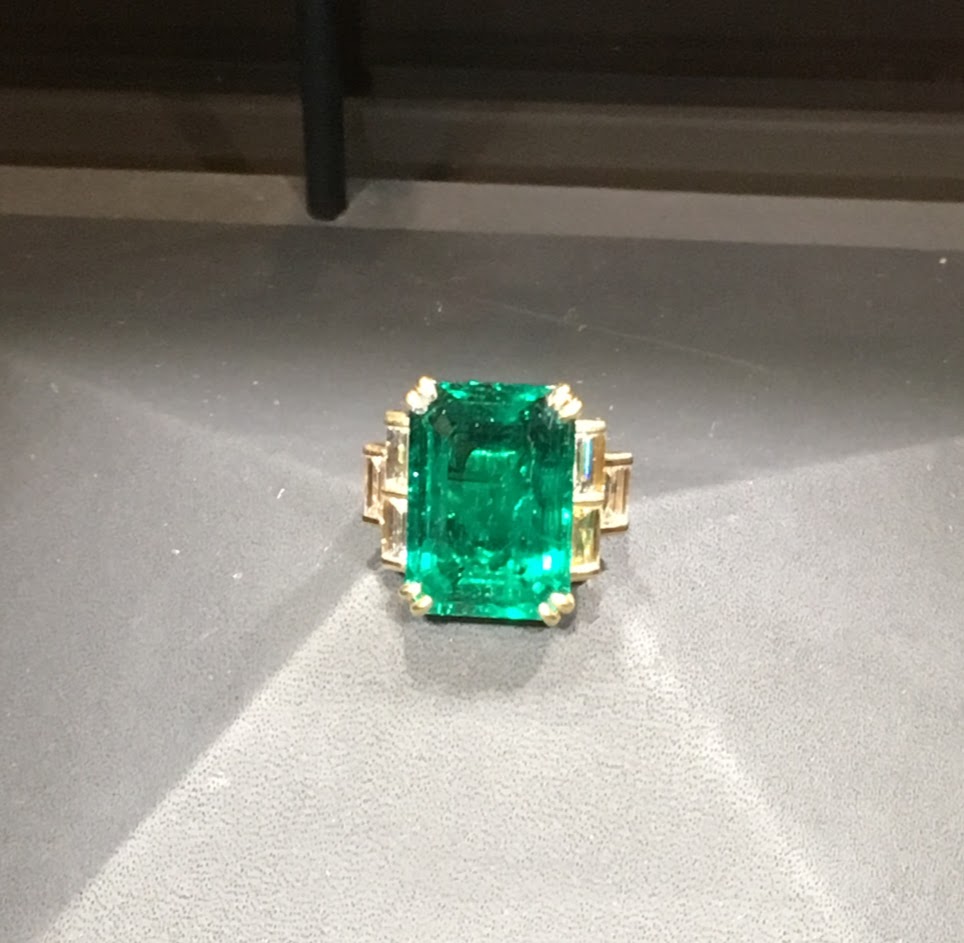
An emerald ring by Reza

I had to cancel an appointment with Olivier Reza, the head of the Parisian jewelry brand, Reza, because the jeweler’s booth was too crowded with customers. 

Van Cleef & Arpels transformable necklace and earrings, 1959, made of emeralds, yellow and blue sapphires, and diamonds

Van Cleef & Arpels and Chopard, the two largest brands in the high jewelry section, brought combinations of vintage and new jewels. 

Chopard L.U.C. XPS made with Fairmined gold

Opening day, March 10, was more manageable but still very crowded. I spoke to one woman lived about an hour away in Germany who said it was the first time she attended an art fair. She came to see Wallace Chan’s exhibit and was so amazed and astounded by what he presented that she returned to the booth seven times. She purchased Chan’s book “Dream Light Water” and had the artist sign it. 

Honcocks of London's booth

Final numbers released by TEFAF show that the fair was very active with more than 71,000 visitors, from more than 60 nations visiting the 275 dealers during the 10-day fair. This includes approximately 200 museums. 

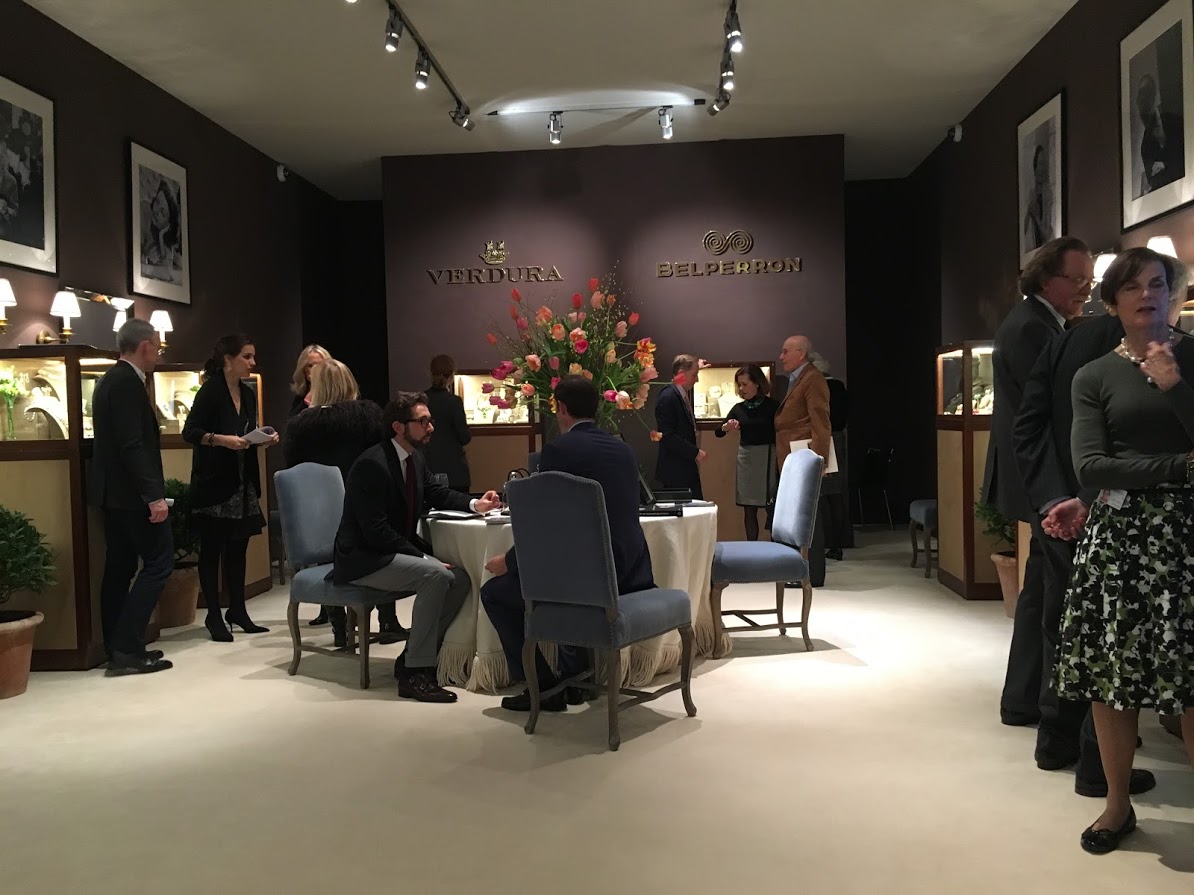
The bust Verdura and Belperron booth

High jewelry amounts to one of nine art categories that TEFAF offers. The others are Antiques, Classical Antiquities, Curated, Design, Modern, Paintings, Paper, and Showcase. Trade fair officials were touting some of the larger sales. Among them:


* Antiquariat Bibermuehle AG Heribert Tenschert sold a 12-volume series of books, Historia naturalis, originally created for Emperor Rudolph II of Habsburg, 1596-1610, to a private collector. The series came to market for the first time in 25 year and was sold for a seven-figure sum. 


* Tomasso Brothers Fine Art sold an important work by the Renaissance master Giambologna (1529-1608). It is the earliest recorded work by the artist and the only surviving sculpture that he carved in wood. The carving was acquired by a new client, described as an important European private collector, and was priced at about €1.5million ($1.62 million). 


* Antiques dealer Les Enluminures sold the 1,000-year-old Gospel Book of Liesborn Abbey in Westphalia to the German government for more than $3 million. 

* Ben Janssens Oriental Art Ltd said he sold more than 70 items by the mid-point of the fair, including a set of four iron paintings, Tiehua, China, Qing dynasty, 18th Century, which had an asking price of €50,000 ($54,000). 

Rossi & Rossi sold a colorful Tibetan cloth painting, “Sabzang Pakpa Zhonnu Lodro” (1358-1412/24) for approximately $400,000. 


The artwork at the entrance of TEFAF Maastricht

* Emanuel von Baeyer sold 12 works to private collectors with further works on reserve with museums. A key work that sold was The Signboard of the Gersaint Gallery, 1732, the very rare engraving after Jean-Antoine Watteau (1684-1721). 


* James Butterwick sold more than €180,000 worth of works, including Still Life with Carafe and Glass on a Mirror, 1915 by Alexander Bogomazov (1880-1930) to a private Swiss collector.

* Landau Fine Art, Inc. had one of the biggest sales of the Fair, selling the monumental work “Henri Michaux acteur Japonais,” 1946 by Jean Dubuffet (1901-1985), which had an asking price of $6.5 million, to a private collector. 

* Bernard de Grunne sold 11 Sepik works from Papua New Guinea to one private collector. The pieces ranged from €80,000 to €250,000 ($86,500 to $270,000). 

* Classical antiquities sold at Charles Ede included a statuette of the “Apis bull, Late Dynastic Period,” 26th Dynasty, circa 664-525 BC, which had an asking price of £65,000 ($81,100), as well as a Graeco-Roman large footed basin, circa 2nd-century BC, with an asking price of £160,000 ($199,650).  

The talk prior to the fair was that art and jewelry sales are down. This is either an exception or the beginning of a new dawn for both the art and jewelry markets. 

Please join me on the Jewelry News Network Facebook Page, on Twitter @JewelryNewsNet, the Forbes website and on Instagram @JewelryNewsNetwork

Monday, October 24, 2016

New Jewels From Wallace Chan, Reza and Otto Jakob At TEFAF New York


In recent years Wallace Chan has increased his participation at international art fairs. Nearly as big a story as the jewels he exhibits are the well-heeled collectors from Hong Kong and China who fly to various parts of the world specifically to support his efforts. TEFAF New York Fall was no different. 

Blue sapphire ring owned by avid collector of Wallace Chan’s works, Lynn Hsieh, a Hong Kong business woman, socialite and former Taiwanese child movie star. She came from Hong Kong to view Chan’s latest exhibition at the TEFAF New York Fall art fair. Photo by Anthony DeMarco

During the press and VIP preview on Friday I met Lynn Hsieh. In addition to being an avid collector of Wallace Chan’s jewels, she is a Hong Kong business woman, socialite and former Taiwanese child movie star. She said she came to both support the artist and possibly add to her collection. She was wearing a ring and matching earrings made of large cabochon blue sapphires highlighted by yellow diamonds, miniature natural pearls and lapis lazuli. 

Matching blue sapphire ring owned by Lynn Hsieh, who came from Hong Kong to view Chan’s latest exhibition at the TEFAF New York Fall art fair. Photo by Anthony DeMarco

Among Chan’s new pieces he brought to the fair is “A Tale of Two Dragons,” a pair of brooches being sold as a set made primarily of a white jade dragon belt hook from china’s Qianlong Period (1736-1795); with emerald, ruby, sapphire, pink sapphire and fancy colored diamonds.

Tale of Two Dragons brooches by Wallace Chan

The white jade was split in two and elaborately carved with titanium and covered with colorful precious gems to create mirror images of a mother and father raising a son and daughter. 

The reverse of the Tale of Two Dragons Brooch shown at TEFAF New York Fall.  Photo by Anthony DeMarco

While Chan is noted for his elaborate artistry and complicated techniques, he also lets particular gems stand largely on their own. This includes another one of his new pieces, the “Night of Violet,” a 116.2-carat amethyst faceted in a pillow-like display on a ring (video at top of the page). The presentation seems simplistic but there is complexity within the piece. Although mounted on titanium, the gem is mysteriously set on the ring without a visible metal claw. The gem is flanked by two triangle-shaped amethysts. The three gems are bordered by rows of yellow and white diamonds. 

A ruby is set at the back of the “Night of Violet” ring, which Chan calls the eye of a dragon, a token of love, power and wisdom. Photo by Anthony DeMarco

Parisian jeweler, Reza, formerly Alexandre Reza, brought new pigeon blood ruby pieces to TEFAF, led by chandelier earrings. Another item of note was a large, elaborate emerald and yellow gold necklace created by the jewelry house in 1980. 

Earrings by Reza feature 34 pebble pigeon blood rubies weighing 35.92 carats, 84 princess cut diamonds weighing 2.19 carats and 148 marquise-cut diamonds weighing 8.69 carats. Set on white polished gold

German jeweler Otto Jakob introduced colorful miniature jewelry creations, including “Bailaoras” earrings made of yellow, rose and white gold, diamonds and vitreous enamel, made by fusing powdered glass to gold by firing. This technique and polishing createsan intense red glow to the poppy feathers. An articulated chain of black diamonds leads to a rose gold capsule with a crown of white gold that is micro pavé-set. 

Emerald and yellow gold necklace created by Reza in 1980. Photo by
Anthony DeMarco

Please join me on the Jewelry News Network Facebook Page, on Twitter @JewelryNewsNet, the Forbes website and on Instagram @JewelryNewsNetwork

Otto Jakob's “Bailaoras” earrings made of yellow, rose and white gold, diamonds and vitreous enamel. Photo by Anthony DeMarco

Friday, October 21, 2016

TEFAF New York Fall Features Contemporary, Vintage and Period High Jewels

“Stilled Life,” brooch by Wallace Chan depicts a cicada made primarily of imperial quality green jade. Its wings are made of wafer-thin green jade and its hands clutch a cabochon lavender jade

The inaugural TEFAF New York Fall art fair opens today (Friday) with a preview starting at 5 p.m. at the Park Avenue Armory that will benefit The Society of Memorial Sloan Kettering. The fair will officially to the general public Saturday and run till October 26.

TEFAF (The European Fine Art Fair) is an offshoot of the famed annual event TEFAF in Maastricht, Netherlands, and the first time the organization is holding its fair outside Europe. Participating dealers were selected by a committee comprising four members of the TEFAF New York Board members and four external US art experts. 

Among the 94 dealers of fine art, design and furniture will be at least 10 high jewelry artists and dealers exhibiting masterpieces in contemporary, antique and period jewels.

Perhaps the most anticipated of the contemporary jewelry artists is Wallace Chan. The Hong Kong-based jeweler is known for his imaginative jewelry designs, groundbreaking gem sculpting techniques and the spectacular prices his creations reportedly earn (even though he never discusses price). Among the pieces he will be showing this year are two sculptured bejeweled brooches.

The first, “Stilled Life,” depicts a cicada made primarily of imperial quality green jade. Its wings are made of wafer-thin green jade and its hands clutch a cabochon lavender jade. Jade beads throughout the piece are embedded using the tenon-and-mortise technique. The overwhelming green of the cicada is the result of Wallace Chan’s jade-thinning-and-luminosity-enhancing invention that he patented in 2002. Pigeon blood ruby eyes provide the finishing touch. 

The piece is billed as a brooch and sculpture. When not worn it comes with a bamboo sculpture of crystal, yellow diamond, pink sapphire, diamond and tsavorite garnet that serves as a base for the winged insect. 

Aspara by Wallace Chan

The second piece is Apsara, Chan’s interpretation of the nymph’s ethereal and artistic qualities that include a body tattooed with cloud-and-water motifs and her gemstone-embellished ribbon resembling trails of stars. In her outstretched hands is a 4.04-carat fancy intense yellow diamond. Other gems include emerald, pink, yellow and green diamonds and crystal.

Emerald and diamond long earrings by Reza

Place Vendôme high jeweler, Reza, is set to unveil a number of high jewelry contemporary works. The centerpiece is a new series of jewelry with gem quality pigeon blood untreated cabochon rubies, richly chromatic and architectural in design. 

Earrings made of jade, diamonds, bronze and white gold by Hemmerle

In addition, there will be two high jewelers from Germany: Hemmerle and Otto Jakob. The first is known for creating colorful, refined artistic jewelry creations using unusual materials such as aluminum and wood. The second specializes in highly detailed and elaborate Renaissance-inspired pieces made of rare and natural materials.

There will be a number of dealers who specialize in antique, vintage and period jewelry and watches. 

Fighting Cock brooches by Cartier made of gold and various gems, 1945, being exhibited by Wartski

Among them is Wartski, the 151-year-old London antique dealer perhaps best known for its “royal warrant of appointment,” as one of a handful of jewelers that supply goods and services to the British royal family. Geoffrey Munn, managing director, is one of Britain’s foremost authorities on antique jewelry with a particular emphasis on 19th-century precious metalwork and Fabergé. The firm is bringing jewels ranging from a 17th Century talisman object to contemporary works from Parisian jeweler, Cartier, and U.S. designer, Tony Duquette. 

The Cole Porter diamond and ruby necklace designed by Fulco, di Verdura, for Paul Flato. It is being exhibited by Siegelson

New York-based Siegelson will be exhibiting a number of pieces including items from Jean Fouquet and Cartier. One highlight is the Cole Porter diamond necklace created by Fulco di Verdura for Paul Flato that simulates a belt with a buckle.

Gold, enamel and diamond Orchid brooch by Paulding Farnham for'Tiffany & Co' New York, 1890 being exhibited by Véronique Bamps

Monaco-based Véronique Bamps specializes in European and American jewelry dating from the early 19th century to the 1950s. She will bring a range of collectible pieces, including a late 19th Century gold, enamel and diamond brooch by Tiffany & Co; as well as jewels from Cartier, René Boivin and Van Cleef & Arpels. 

Diamond and platinum ring by Suzanne Belperron, circa 1930, being exhibited by SJ Shrubsole 

Among the jewelry pieces being shown by New York-based Primavera Gallery is a Victorian ring for Queen Mary of Scots. SJ Shrubsole, also in New York, will showcase a diamond and platinum ring by Suzanne Belperron. From the Netherlands is A. Aardewerk Antiquair Juwelier.  

In addition to jewelry, exhibitors will present works across multiple collecting areas including furniture, art and interior design. It also includes at decoration, ceramics, glass, silver, textiles, tapestries, antiquities, paintings, sculptures, books, manuscripts, autographs, arms and armor, Tribal, Oceanic and Ethnographic Art, Asian Art and Fabergé.

The New York Fall fair is a joint venture between TEFAF and the art investment advisory firm, Artvest Partners. 

Please join me on the Jewelry News Network Facebook Page, on Twitter @JewelryNewsNet, the Forbes website and on Instagram @JewelryNewsNetwork

Sunday, January 31, 2016

Wallace Chan’s New Book Takes Readers Inside His Jewels

"Wallace Chan Dream Light Water" is now available in the US. It contains 86 of his sculptural jewels in extreme close-ups and in their actual size

It’s my belief that 100 years from now Wallace Chan won’t be known as a jeweler or jewelry artist, but simply as an artist. He will be considered among the best of his time, if not longer. That his groundbreaking gem carving and faceting techniques and his jewelry making skills will be taught at art schools and gemology schools around the world.

The China native and now Hong Kong-based jewelry artist who grew up in extreme poverty is already successful beyond his wildest imagination among the most elite in the world in money and taste. His notoriety will likely grow with the January 28 release of the book “Wallace Chan Dream Light Water,” designed to open up the process of his techniques to the public.

Wallace Chan with Sarah Coffin, a curator at Cooper Hewitt Museum (left) and Cherry Rao

On the day of the book’s release Chan gave a lecture at the Cooper Hewitt, Smithsonian Design Museum in New York. The book contains photographs of 86 of his sculptural jewels in extreme close-ups and in their actual size. Even at $280 each, the museum’s allotment of the 380-page tome sold out before Chan took the stage.

Chan discussed his quest for knowledge even though he was too poor to receive a formal education.

“I started from reading books I could not understand to wanting books I could not afford and today I have made a book of my own,” Chan told an audience of jewelry and art professionals and enthusiasts at Cooper Hewitt. “I have met a lot of challenges along the way.”

From concept to publishing, the book took seven years to make, Chan told the audience, or as he told me previously, “nothing comes easy” for him.

Vividity brooch centered with a rare elbaite tourmaline

Chan also brought one of his more famous creations with him as an exhibit for the event: “Vividity,” a colorful brooch centered with a rare elbaite tourmaline.

Chan told me in October when he first came to New York to promote the book that he chose to photograph the jewels in extreme detail in order to reveal the techniques he uses so others can learn from them—such as his use of gems as prongs instead of metal, how he manipulates precious metals, and his approach to faceting jade.

“Books are just like jewelry,” Chan told the audience through his editor and translator, Cherry Rao. “They are embodiments of human cultures and emotions. With this book I hope to show you a world that you cannot see—a micro world of jewelry where you can find the hidden truth, goodness and beauty in the gemstone and the craftsmanship.

A close-up view of the Now and Always necklace featuring the "Wallace Cut"

The book cover is a photograph of his most famous gem carving technique: The Wallace Cut, where he creates a reverse image in the back of a gem using cameo and intaglio carving techniques that result in a multiple-dimensional trompe l’oeil effect when seen from the front of the gem.

“On the front you can see five faces but actually I only carved one face at the back of the stone and the four more faces you see are actually the result of reflections that was created by precise calculations and faceting,” Chan said.

A close-up view of the Fluttery Ragtime Brooch

“It was reverse thinking combined with reverse carving motions. What you see on the right I actually carved on the left and what you see that is deep inside the stone was actually carved shallowly and by design.”

A full view of the Fluttery Ragtime Brooch

It took Chan two and a half years to master this approach to jewelry carving, which he first revealed in 1987, and another six months to build the tools, which include dentist instruments adapted for gem carving. He then had to carve while the gem was submerged in water because the carving tools generated too much heat that could damage or crack the gem. Not to mention burn his hands.

An extreme close up view of Parure Plum Flowers in Snow

“As I was carving in water it meant I could not see the details so I was doing the carving stroke by stroke,” he told the audience. “I had to carve one line and then I had to take it out of the water and check it to see if it is okay. I put it back down into the water to do another stroke. It was a long process but I entered a stage where my eyes, my heart my hands were moving as one. By that time I could carve in the water for two or three minutes without looking or checking.

“It was the craziest period in my life. At that time I was completely lost in the magic of light and shadow.”

A full view of the Fluttery Ragtime Brooch

Chan’s reputation transcends jewels and goes into art. He is a sculptor by training and still creates many traditional works of sculpture as well as large glass etchings. Sarah Coffin, a curator at Cooper Hewitt who led the lecture, asked Chan about his artistic approach to his jewelry designs.

“Painters use paint, musicians use notes and I use gemstones to create,” Chan said. “Jewelry is the same as paintings or music. It is a form of expression in art. For more than four decades gemstones have been the most important language I use to communicate with nature and the universe. The carvings, sculptured gemstone cuttings or jewelry creations use gemstones as my medium … and through creation I become one with nature.”

Heart in Bloom brooch

The book, Wallace Chan Dream Light Water,” published by Rizzoli, is co-written by Juliet de La Rochefoucauld, a gemologist, jewelry historian, author and lecturer. The 380-page 11-in. by 15-in. book contains 260 color photographs and illustrations. It retails for $280. Demand has already proven to be strong as the allotment at the Cooper-Hewitt museum sold out during Chan’s lecture Thursday.

Please join me on the Jewelry News Network Facebook Page, on Twitter @JewelryNewsNet, the Forbes website and on Instagram @JewelryNewsNetwork