Asteria Colored Diamonds

Asteria Colored Diamonds

TechForm

TechForm Platinum Jewelry Casting

Leibish & Co

Showing posts with label rubies. Show all posts

Friday, May 19, 2017

Gemfields Biggest Shareholder Makes Unsolicited Offer For Remaining Shares

Emerald and diamond necklace by Carolina Bucci using Gemfields Zambian emeralds 

Private equity company, Pallinghurst Resources, has made an unsolicited offer for the 53% of shares in Gemfields it does not already own. 

Pallinghurst, based in South Africa, specializes in investments in the mining sector. It is offering approximately $150 million in its shares for the remaining stake in Gemfields, a London-based colored gemstone mining and marketing company, making it a core component of Pallinghurst’s value. 

Pallinghurst’s offer doesn’t provide any added value to Gemfields, which it values at approximately $295 million.

Gemfields Board, in a statement to shareholders, “strongly advises … to take no action at this time.” However, Gemfields shareholders owning 28% of the company had already agreed to the offer, Pallinghurst says, giving it 75 percent backing and making the offer unconditional. 

Gemfields in its current form was created in 2008 when Pallinghurst and its co-investors contributed the Kagem emerald mine to Gemfields, its core operating asset, for shares. This transaction made Pallinghurst and its co-investors the majority shareholders of Gemfields. In 2013, Pallinghurst added the luxury brand, Fabergé, to Gemfields holdings, increasing Pallinghurst group’s direct ownership in Gemfields to the current level of 47.09%.

The strategy from the beginning was for Gemfields to become the “De Beers of the Colored Gemstone Industry” by creating a mine-to-market strategy for its responsibly sourced gems that could be traced throughout the supply chain and communicated to the industry and consumers. Part of this communication involves creating a grading system for determining emerald quality. 

Pallinghurst contends that Gemfields is “an attractive and unique business” but in its current structure is constrained by limited access to equity and debt capital, low share liquidity and high costs.

“Pallinghurst believes that, since its investment, the performance of the Gemfields share price has been disappointing and despite the major positive developments, Gemfields’ shareholders, including Pallinghurst, have not benefited appropriately,” Pallinghurst said in a statement. “The share price of Gemfields has not increased over the last decade.” 

Gemfields key holdings are: 

* 75% of the Kagem emerald mine in Zambia; 
* 75% of the Montepuez ruby mine in Mozambique; 
* 50% of the Kariba amethyst mine in Zambia; and 
* 100% of Fabergé Limited. 

Once gaining full control of Gemfields, Pallinghurst will delist Gemfields from the Alternative Investment Market (AIM), a sub-market of the London Stock Exchange for smaller, less-viable companies, and take it private, at least for the time being. Pallinghurst is listed on the Johannesburg Stock Exchange (JSE) and the Bermuda Stock Exchange (BSX) and it said it would consider listing Gemfields on the LSE.

Pallinghurst, in order to create profitability for Gemfields, said it would do the following: 

* Focus on Gemfields’ core emerald and ruby operations in Zambia and Mozambique, respectively, and develop these to optimal scale;
* Accelerate the development of its existing portfolio of projects to mitigate the dependency on its attractive, but cyclical assets;
* Explore strategic alternatives for Fabergé, where significant growth capital is still required to reach its full potential; and
* Pursue cost reductions across the enlarged group.

Gemfields sells its rough gems through international auctions, which Pallinghurst says has “brought a level of professionalism and transparency previously not seen in the industry.” With its proprietary grading system for gems, Gemfields developed three auction classes, one offering higher quality gemstones, one for the larger volume of lower quality gemstones and the last offering mixed quality gemstones.

Pallinghurst said acquiring all of Gemfields would allow it to collapse its investment structure and simplify its management arrangements.

“The result will be a renewed Pallinghurst with a simplified operating model and an in-house management team,” Pallinghurst said in a statement. “The value of the underlying assets will be more clearly demonstrable with clearer earnings and operating metrics that can be benchmarked against industry peers. The revised structure model will allow Pallinghurst to rationalize costs across the group by simplifying the group's structures.”

The statement continued, “Post completion … Pallinghurst expects to have an enlarged market capitalization, improved trading liquidity and equity broker coverage. The board of directors of Pallinghurst believes that the combination of these factors should be value accretive for all shareholders.” 

Please join me on the Jewelry News Network Facebook Page, on Twitter @JewelryNewsNet, the Forbes website and on Instagram @JewelryNewsNetwork

Wednesday, May 17, 2017

92-Carat Heart-Shaped Diamond Fetches World Auction Record $14.9


A 92-carat D Flawless heart-shaped diamond sold for $14.9 million at Christie’s Geneva Magnificent Jewels sale Wednesday. It set a world record for the price of a heart-shaped diamond sold at auction. 

It sold just above its $14 million low estimate. The jewel was given the name, La Légende. It was created by Boehmer et Bassenge, a high jewelry house that was launched a year ago. The company began working with the auction house last year.


Another big sale for the evening was a 15.03-carat unheated Burmese ruby mounted on a diamond ring that sold for $12.9 million ($861,000 per carat), within its estimate of $10 - $15 million.

In addition, a 7.97-carat fancy intense blue cushion-shaped diamond fetched more than $12.7 million, smashing its $3 million high estimate and setting an auction record per carat at $1.6 million, according to Christie’s. 

These were the top three items of the sale held at the Four Seasons Hotel des Bergues that featured 267 lots, achieving $94.5 million, with 85% sold by lot and 90% sold by value.  

Other highlights include:

A 56.03-carat, pear-shaped D color, potentially IF diamond pendent on a diamond necklace by Chopard fetched $6.3 million ($113,000 per carat);

A 4.05-carat square-cut, fancy deep blue VS1 diamond sold for $4.3 million ($1.05 million per carat);

A 47.63-carat cushion-shaped Burmese sapphire sold for more than $2.4 million ($50,500 per carat), three times its high estimate. 

A ruby and diamond four leaf clover brooch by Boucheron fetched $2.2 million, three times its high estimate. 

Please join me on the Jewelry News Network Facebook Page, on Twitter @JewelryNewsNet, the Forbes website and on Instagram @JewelryNewsNetwork

Monday, March 27, 2017

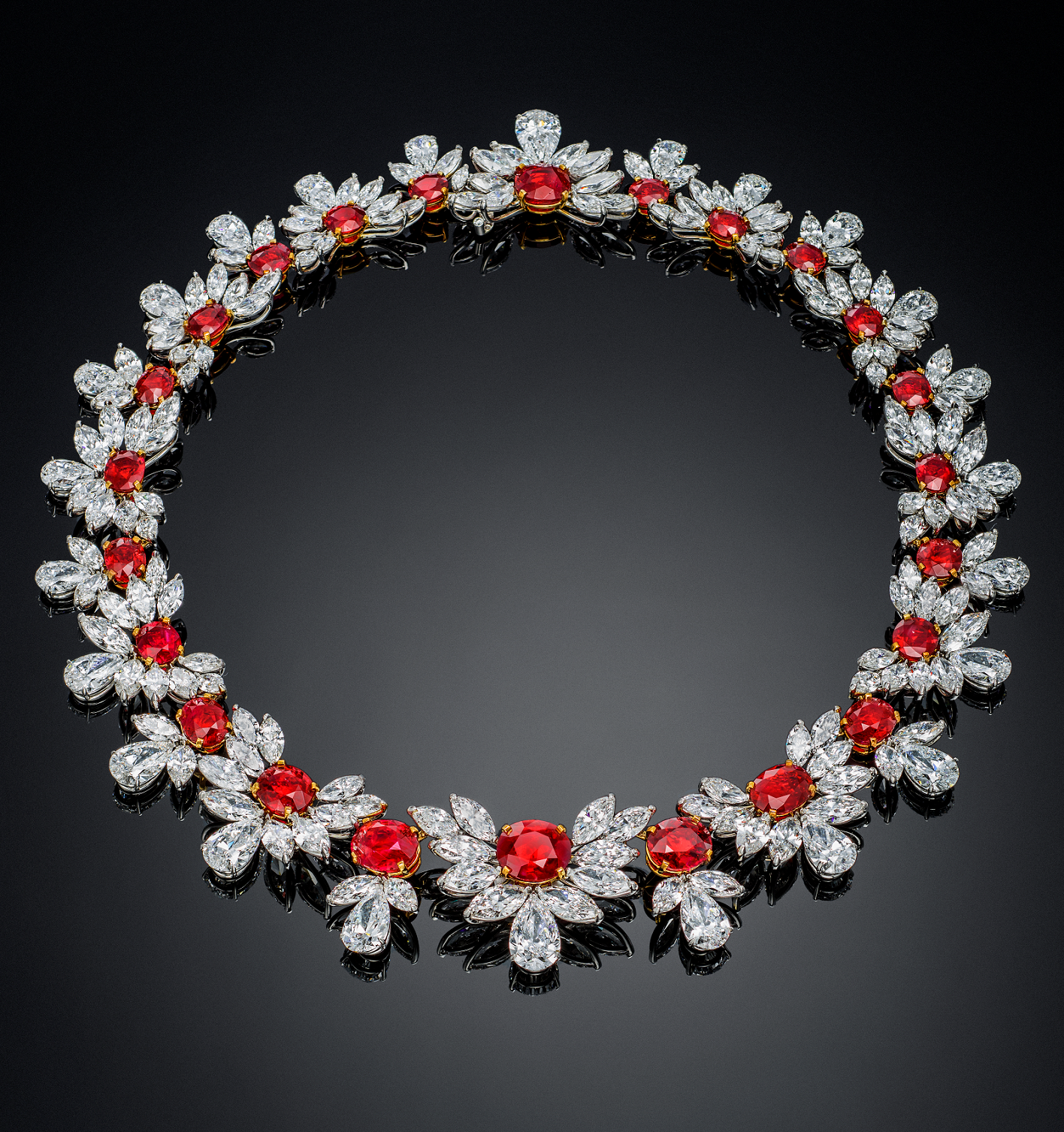
Faidee’s Latest Masterpiece Is The $35 Million ‘Grand Phoenix’ Ruby Necklace


One could say that the latest Faidee creation is an expression of the esteemed company’s 100-plus year history spanning four generations. 

The family owned firm that specializes exclusively in Burmese rubies unveiled “The Grand Phoenix” during the Baselworld watch and jewelry trade show in Basel, Switzerland. 

Even for a company with the pedigree of Faidee—known for dealing with exceptional rubies (and Kashmir sapphires) and creating equally exceptional and extremely expensive jewels—this is something special. 


The regal necklace made of 24 “super exceptional” unheated Burmese rubies totaling 59.83 carats. The individual rubies range in weight from one to six carats. The “pigeon’s blood” gems are accented with 100.21 carats of colorless, flawless and internally flawless fancy shaped diamonds—the highest color and clarity grades. This ruby and diamond combination in a flower motif is Faidee signature creation.

The necklace is valued at $35 million, said Ravi Lunia, Faidee director.


“The Grand Phoenix is an exceptional masterpiece; a collection of flawless rubies spanning over four generations,” Lunia said. “To find a single exceptional ruby of this caliber is a daunting task but with our passion and burning desire to excel beyond perfection, we’ve managed a miracle that has never been attained in the history of the jewelry industry.” 

The press conference also served to announce that The Phoenix Necklace will be the centerpiece of a jewelry exhibition of Faidee’s creative jewels and private ruby collection. The exhibition will be presented by the Stardust Monte-Carlo, a longtime Monaco-based luxury jeweler. It will be held at the Hotel Hermitage, Salon Belle Epoque, Monte-Carlo, August 1 - August 21.

At the press conference with Lunia was Claudio Siffredi, owner of the Stardust Monte-Carlo. 


The necklace was on display on the neck of Faidee’s Ambassador, Anna Andres, a Ukrainian lawyer, actress and model who holds the title of Miss Ukraine Universe 2014.

For more than 100 years Faidee has been known as the premiere company that deals exclusively in Burmese rubies—known for their intense, vivid red hues (“pigeon’s blood” is the term used to describe this coloration). The family owned firm has history of creating jewels with these gems that are sold privately and through the international auction market easily selling for millions of dollars. Most recently, the “Ratnaraj,” a 10.05-carat ruby set on a diamond ring sold for more than $10.2 million at Christie’s Hong Kong (more than $1 million per carat). 

It’s going to be a long time before Faidee tops this latest achievement. 

Please join me on the Jewelry News Network Facebook Page, on Twitter @JewelryNewsNet, the Forbes website and on Instagram @JewelryNewsNetwork

Friday, July 22, 2016

Miners Partner With Designers To Create Sustainable Jewels

Emerald and diamond necklace by Carolina Bucci using Gemfields Zambian emeralds 

Two London-based mining companies worked with jewellery designers to create new pieces that promote the sustainable and humane practices of the mines they operate. Another key selling point is provenance, knowing which mine the gems were unearthed.

London-based mining and marketing company, Gemfields, worked with MUSE, a New York showroom for emerging and established fine jewellery designers, for a collection of limited-edition and well-priced jewels. Designers Carolina Bucci, Dezso by Sara Beltrán, Elena Votsi, Holly Dyment, Michelle Fantaci, Nikos Koulis, Savannah Stranger, Silvia Furmanovich, Yossi Harari and AYA by Chelsy Davy unveiled a range of jewels at the Couture Show using Mozambican rubies and Zambian emeralds from Gemfields’ mines in those two countries.

“Rose Petal” earrings by Silvia Furmanovich using Gemfields Mozambican rubies

Most styles are based on each of the designers’ bestsellers, recreated with Gemfields rubies and emeralds. The collection is for everyday wear targeting a fashion-forward consumer, with the majority of the limited production collection falling within the $1,000 and $10,000 price range (with the exception of a few high value statement pieces).

This type of approach isn’t new for Gemfields. The company has been producing collections through partnerships with designers (experienced and emerging) for a number of years. The difference with this particular collection is its affordability.

Ruby and diamond “Crisscross” ring by Yossi Harari using Gemfields Mozambican rubies

“Having done collaborations at both ends of the spectrum, we see the alignment with MUSE as the perfect opportunity to showcase the versatility of color and connect with a fresh new audience,” said Gabriella Harvey, Gemfields director of Procurement and Product Services.

18k yellow gold and diamond earrings by Suzanne Kalan with diamonds from Rio Tinto’s Argyle mine

Mining giant Rio Tinto used unveiled their “Diamonds with Story” collection, working with six US designers: Paige Novick, Xiao Wang, Jennifer Dawes, Matthew Campbell Laurenza, Suzanne Kalan and Sandy Leong. All of the diamonds are sourced from Rio Tinto’s Argyle Mine in Western Australia. The mine is most famously known for its rare Argyle pink diamonds. However, diamonds being used for the collections are primarily white and champagne.

The “Infinity’ three row curved ring by Paige Novick with diamond pave from Rio Tinto’s Argyle mine

Like Gemfields, affordability is important with these creations. Unlike Gemfields, all of the designers are experienced and well-known to the trade and consumers.

18k yellow gold band, 6g, .53ctw rose cut cognac diamonds, .05ctw round brilliant cut diamonds by Jennifer Dawes using Rio Tinto diamonds from its Argyle mine

“Increasingly, the value of a diamond is tied to where and how the diamond was mined, how it was cut and polished, and the process of bringing it to sale,” said Bruno Sané, general manager of marketing for Rio Tinto Diamonds. “This is a very reasonable expectation that is steadily reshaping the diamond industry for the better.” 

Please join me on the Jewelry News Network Facebook Page, on Twitter @JewelryNewsNet, the Forbes website and on Instagram @JewelryNewsNetwork

Tuesday, May 12, 2015

25-Carat Ruby Ring By Cartier Fetches World Auction Record $30.4 Million


Additional reporting by Gretchen Friedrich, Jewelry News Network social media manager

The 25.59-carat “Sunrise Ruby” by Cartier smashes estimates to fetch $30.38 million, a world record for a price of a ruby at auction. It was the surprising top lot Sotheby’s Geneva Magnificent Jewels and Noble Jewels Sale held Tuesday at the Hôtel Beau-Rivage. 

Known as the “Sunrise Ruby,” it’s described as a “unique treasure of nature” by the Swiss Gemmological Institute. The ruby didn’t receive any heat treatment and the color is described by that famous auction moniker for exceptional rubies, “pigeon’s blood” red: the rarest and most sought-after of hues. 

The ruby was the high point in a jewelry auction that saw many highs, taking in approximately $134 million, with 93.5 percent of the 484 lots sold. The top ten results were a mix of colored gems and diamonds along with white diamonds, natural pearls and three other Cartier jewels. 


Going into the auction, the top lot was expected to be the “Historic Pink,”  (pictured above) an 8.72-carat Fancy Vivid Pink diamond that the auction house described as “extremely rare and highly important.” This turned out to be the second highest lot of the sale, fetching $16 million, within its estimate. The jewel is believed to have been part of the collection of Princess Mathilde, the niece of Napoleon Bonaparte. The stone, which has VS2 clarity, is also distinguished by its classic non-modified cushion cut, unusual in a pink diamond, Sotheby’s said. 


A custom-made diamond necklace of more than 190 carats by Cartier (pictured above) sold for $7.25 million. The piece was designed as a cascade of diamonds, the front accented with a floral motif and suspending a fringe of nine pear-shaped stones.

Despite an auction season that has had its share of high and lows, one category of jewelry that continues to see consistently higher prices are natural pearls. This auction didn’t disappoint as three pearl jewels were among the top 10 lots.

The first was a natural pearl and diamond necklace that has at least least some Cartier lineage (signed clasp and case stamp) that sold for $7 million (pictured above), well above its high estimate. It is composed of two graduated strands of 78 natural pearls on a clasp set with a marquise-shaped diamond weighing 4.39 carats.

In addition, a single strand necklace composed of a graduated row of natural pearls measuring from 7.95 to 12.40mm, on a barrel clasp set with brilliant-cut diamonds sold for $3.8 million, totally obliterating its high estimate of approximately $527,000.


The other Cartier pieces that sparkled at the auction were a brooch set with a 30.23-carat Kashmir sapphire that sold for $6.1 million; and sapphire and diamond earrings of the same design made with two Burmese Mogok sapphires of 15.77 and 16.90 carats. This sold for $3.43 million, well above its high estimate.

The other top lots are as follows:

* A 32-carat colorless diamond ring sold for more than $4 million. It was one of two colorless diamonds among the top 10 lots.

* The other was a pair of earrings each suspending a cushion-shaped diamond weighing 10.02 and 10.03 carats, from a line of single-cut diamonds, which sold for $3.2 million.

* Rounding out the top 10 was a natural pearl and diamond ear clips that sold for $3.2 million.

Please join me on the Jewelry News Network Facebook Page, on Twitter @JewelryNewsNet and on the Forbes website.


Monday, August 23, 2010

‘The Gem Hunter’ Provides Help to Afghan Gem Industry

American author and humanitarian Gary Bowersox, is in Kabul, Afghanistan, to assist the US government in revitalizing the Afghan gemstone industry while delivering help to Afghan children.  

Bowersox, also known as the “The Gem Hunter,” is leading a trip of 30 Afghan miners and dealers to travel to the Hong Kong Gem & Jewelry Fair (September 14-20).

The project is sponsored by the United States Agency for International Development (USAID), specifically its Afghanistan Small and Medium Enterprise Development (ASMED). It’s a joint effort with Development Alternatives, Inc. (DAI), a global consulting firm that provides social and economic development solutions. The full acronym for the effort is (Are you ready?): USAID/DAI/ASMED. Bowersox serves as the senior advisor for the gem industry.

Bowersox said most of the miners and dealers have never been outside Afghanistan, have no business background and only a few speak English. “It is a real challenge,” he said.

Bowersox, who lives in Hawaii, has spent the past year visiting the emerald mines in Panjshir Valley and the ruby mines at Jegdalek. In addition, he traveled to the schools in the mining areas as a representative of the Hawaii Kai Rotary International project to furnish school supplies for Afghan children and at the same time delivering eye glasses for the Kamehameha Lions Club. Bowersox is a member of both clubs.

“The poverty these poor children live in would shake anybody with any sense of dignity to their souls,” Bowersox said.

Bowersox said one of the best ways to help the people of Afghanistan is to purchase the country’s gems, which is a legally exported product. Opium is country’s largest illegal export. Among the gems found in Afghanistan are emeralds, tourmaline, spodumene, rubies and lapis lazuli—the country’s best-known gem.

Bowersox has been in the gem business for 40 years. His relationship with Afghanistan is long. In 1976, he received an exclusive license from the Ministry of Commerce of Afghanistan to import lapis-lazuli into the United States. In 1996, the Ministry of Mines and Industry in Kabul, Afghanistan appointed Bowersox as consultant to the ministry. However, continued fighting in Afghanistan has hindered many projects. In 2002, he was the subject in a documentary called The Gem Hunter in Afghanistan, which follows Bowersox from the Peshawar gem market over the high mountain passes of the Hindu Kush, and the steep mountain slopes to the Lapis and the Emerald mines of Afghanistan. He also authored the book about his experiences in Afghanistan called, The Gem Hunter.

Bowersox owns and operates GeoVision, Inc., in Hawaii, where he deals in gems and minerals from many parts of the world, including Afghanistan, Brazil, Burma, India, Kenya, Kazakistan, Kyrgistan, Madagascar, Pakistan, and Thailand.

Caption: Gary Bowersox (right) with the Afghan Minister of Mines H.E. Wahidullah Shahrani.