Asteria Colored Diamonds

Asteria Colored Diamonds

TechForm

TechForm Platinum Jewelry Casting

Leibish & Co

Showing posts with label silver. Show all posts

Friday, April 1, 2016

Zaha Hadid’s Leaves Landmark Jewelry Line For Georg Jensen Before Untimely Death

The Georg Jensen cuff bracelet designed by Zaha Hadid

The story I was going to write today was to be a bit different then how it now appears. One of the highlights from an otherwise lackluster Baselworld 2016 was the public introduction of a new Georg Jensen jewelry collection designed by the famed architect Zaha Hadid. 

But the narrative changed with the sudden and unexpected death of Ms. Hadid Thursday. The world’s most famous and accomplished woman architect died of a heart attack. She was 65. 

Zaha Hadid Photo courtesy of Georg Jensen

The jewelry collection she designed for Georg Jensen, called the “Georg Jensen X Zaha Hadid The Lamellae Collection,” has the potential to be a landmark moment for the famed Danish silversmith brand. That may still be the case but it also will be likely remembered as Ms. Hadid’s last completed project—even though it is on a much smaller scale than her futuristic curved buildings. 

Georg Jensen ring designed by Zaha Hadid

Ms. Hadid, in a prepared statement, discussed working at a smaller scale and with nature-inspired shapes that are synonymous with the Georg Jensen brand.

“Working with Georg Jensen presented an opportunity to express our ideas in different scales and through different media,” she said. “Our starting point was the Danish house’s design links to nature. There is an inherent integrity within the organic structural logic found in nature and we often look at the coherence of natural systems when we work to create environments. Our challenge was to translate that into something that can be worn; to reinterpret the rich history and tradition of Georg Jensen’s design approach into something new.”

The cuff bracelet worn by the new CEO of Georg Jensen, Eva-Lotta Sjöstedt during Baselworld 2016. Photo by Anthony DeMarco

The jewelry collection of five rings and three cuff bangles were inspired by the Wangjing Soho near Beijing, designed by Ms. Hadid, an approximate 4.2-million square-foot retail and office complex of three curvilinear asymmetric buildings that appear to circle one another and change appearance with the light of the day and the angle they are viewed. The buildings with distinct lines between each floor of windows have been described as appearing like “dancing Chinese fans” and “curved sails.” The architect has reportedly said the buildings were supposed to resemble koi swimming around each other in a pond. 

The full collection in sterling silver plated black rhodium set with black diamonds. Photo by Anthony DeMarco

Georg Jensen was acquired in 2012 by the holding company, Investcorp and David Chu, who serves as creative director and chairman of the brand. His task he told me a year ago was to take the company’s heritage and modernize it for the 21st Century. One of the things he started doing was to develop partnerships with well known designers and artists, which was part of the company’s heritage that somehow it lost. 


As the story goes Chu sat next to Ms. Hadid at dinner in Beijing for the official opening of the Wangjing Soho project in September 2014. They immediately decided then to collaborate on a jewelry line.

Also involved in the project was Meeling Wong, Georg Jensen managing director of Jewelry. Wong said she first met Ms. Hadid in November 2014 at her London headquarters. Wong described the working process as a "true collaboration."

"We worked very closely with her design team, in person, phone and emails. It was a very fluid process and a close partnership. I went to their London studio to show the first prototypes, and met with them several times in person," Wong said. "Zaha trusted that we would execute her designs so that they can be worn."

Crafted in both sterling silver and sterling silver plated black rhodium set with black diamonds, the jewels in the collection feature smooth flowing ribbon-like shapes contrasted with sharp edges. The silver naturally alternates between a polished and matte effect, while the black rhodium set with black diamond pieces have a subtle gleam to the graphic, architectural forms. The signature piece in the collection has to be the lengthy cuff bracelet that wraps the wrist and engages light. 

The public seating area just outside the Georg Jensen exhibition space

This is not just a “starchitect” putting her name on a product. This is a well-thought out contemporary, architecturally influenced collection of jewels that express modern elegance.

Wong described Ms. Hadid's involvement with the project as "total engagement and focus on arriving at a final result that did not compromise or dilute the original design and concept."

For Georg Jensen it is by far the most on-brand jewelry product, and perhaps overall product, it has produced since the new owners began its campaign to rejuvenate the brand. It is an original design with a contemporary motif that moves the brand forward into the modern era. 

The brand must have known it had something special as it pulled out all the stops in presenting the collection in Baselworld. This included creating an installation of the design motif in the exhibition space and seating area just outside the booth. 


“There is continuity in Zaha’s collection—and, indeed, in her work—that reflects the history of our iconic jewelry design celebrating nature’s seemingly simple yet mathematical forms,” Chu said in a prepared statement. “It is a proud continuation of Georg Jensen’s modernist design signature and a century of collaborating with designers whose vision transforms the way we think.”

And, unfortunately, it is also the end of the relationship.

The collection will be available in September.

Please join me on the Jewelry News Network Facebook Page, on Twitter @JewelryNewsNet, the Forbes website and on Instagram @JewelryNewsNetwork

Friday, March 4, 2016

How Do I Choose The Best Precious Metal Alloy For My Jewelry?


This is the first in a monthly series of educational articles for jewelry professionals and consumers by Teresa Frye, founder of TechForm Advanced Casting  

The precious metal alloy you choose for your jewelry can make a world of difference for both the manufacture of your designs and consumers. Therefore, understanding the risks and benefits associated with alloy choices can go far towards assuring that you get the look you want and the quality you need. Every jeweler benefits from a deeper understanding of an alloy’s characteristics. Listed below are the most important of these characteristics.

Color
While this one may seem obvious, there is a lot of nuance in the world of color that can make a big difference in the end product. For example, matching a 950 platinum cobalt wedding band with a 950 platinum ruthenium engagement ring will yield a noticeably different color between the two. And while this might not be obvious when the ring is new and highly polished, with time and wear it will become more apparent. White gold runs the same risk. When gold alloys are whitened with palladium versus nickel, the latter will be much whiter than the former. Therefore, it is a good idea to do your homework and find suitable color matches, whether you are trying to match a customer’s existing piece of jewelry or launch a new line.

Tarnish Resistance
Although most jewelers are fairly well-versed in tarnish resistance, most consumers are not. A full understanding and disclosure of tarnish resistance for the products you sell will go far to protect your reputation. White gold tarnishing is probably the least understood by the consumer, so extra care should be taken at the point of sale to assure they understand that the metal will change color over time or that rhodium plating has been used and will eventually start to wear off. Your metal supplier should know how their alloys perform and can help you with the information you need to inform your customers.


Molten Fluidity
When you design it is important to understand the molten fluidity of your chosen alloys. While silver and yellow gold alloys have high fluidity that enable good flow into fine cross-sections, platinum and some of the white gold alloys do not. Fluidity is determined by a number of factors including an alloy’s solidification range. Alloys with inherently low fluidity, such as platinum ruthenium, need larger sprues and generally larger cross-sections to adequately fill all features of the design. If you are unsure of an alloy’s fluidity, your caster or the technical contact at your alloy supplier should be able to help.

Mechanical Properties
The mechanical properties for an alloy, including strength, ductility and hardness measurements, are crucial to understanding how your jewelry will wear for the consumer. In addition, they also indicate how an alloy will behave on the bench in terms of finishing and setting. The most common mechanical property cited in the jewelry industry is hardness, although this is only one measure and not necessarily the most important one for jewelry manufacturing. It is equally important to know how strong an alloy is to assure it will not distort with normal wear, or how ductile it is, which will indicate the degree of ease in setting. For example, while 950 platinum iridium is a dream to cast, polish and set, it has very low strength and hardness. If you understand the mechanical properties of this alloy, you will immediately conclude that the consumer cannot be well-served because your design will easily distort and potentially lose stones. Simply switching to a stronger alloy will shift these properties higher and protect your design from unnecessary failures. Your alloy supplier should be able to give you mechanical properties for your alloys if you do not already have them. 

8mm platinum Lattice ring with pave-set white diamonds by Etienne Perret

Hypo-allergenic Properties
Lastly, it is important to know whether your alloy contains nickel. A small but significant portion of the population has nickel sensitivity. Typically, these individuals already had some reaction to a jewelry metal in the past, and they will be looking to you to assure they get the right metal to avoid reactions in the future. Ask your metal supplier for a breakdown of the elements in their gold alloys, and avoid any that contain nickel. Another option is to use a platinum alloy composed of only platinum group metals, such as 950 platinum ruthenium or 900 platinum iridium. These alloys have no known instances of allergic reactions and are safest for those who are highly sensitive to base metals.

Teresa Frye is founder of TechForm, which specializes in the casting of platinum group metals for the jewelry, medical, and aerospace industries. She is also founder of the Portland Jewelry Symposium, an annual gathering of custom jewelers, designers, and retailers described as a “great think tank” for jewelers who are passionate about their craft. Frye is a renowned specialist on the casting of platinum group metals who speaks at jewelry events throughout the world. 

Please join me on the Jewelry News Network Facebook Page, on Twitter @JewelryNewsNet, the Forbes website and on Instagram @JewelryNewsNetwork

Saturday, June 27, 2015

Christofle Creates Silver Crowns As Art Objects

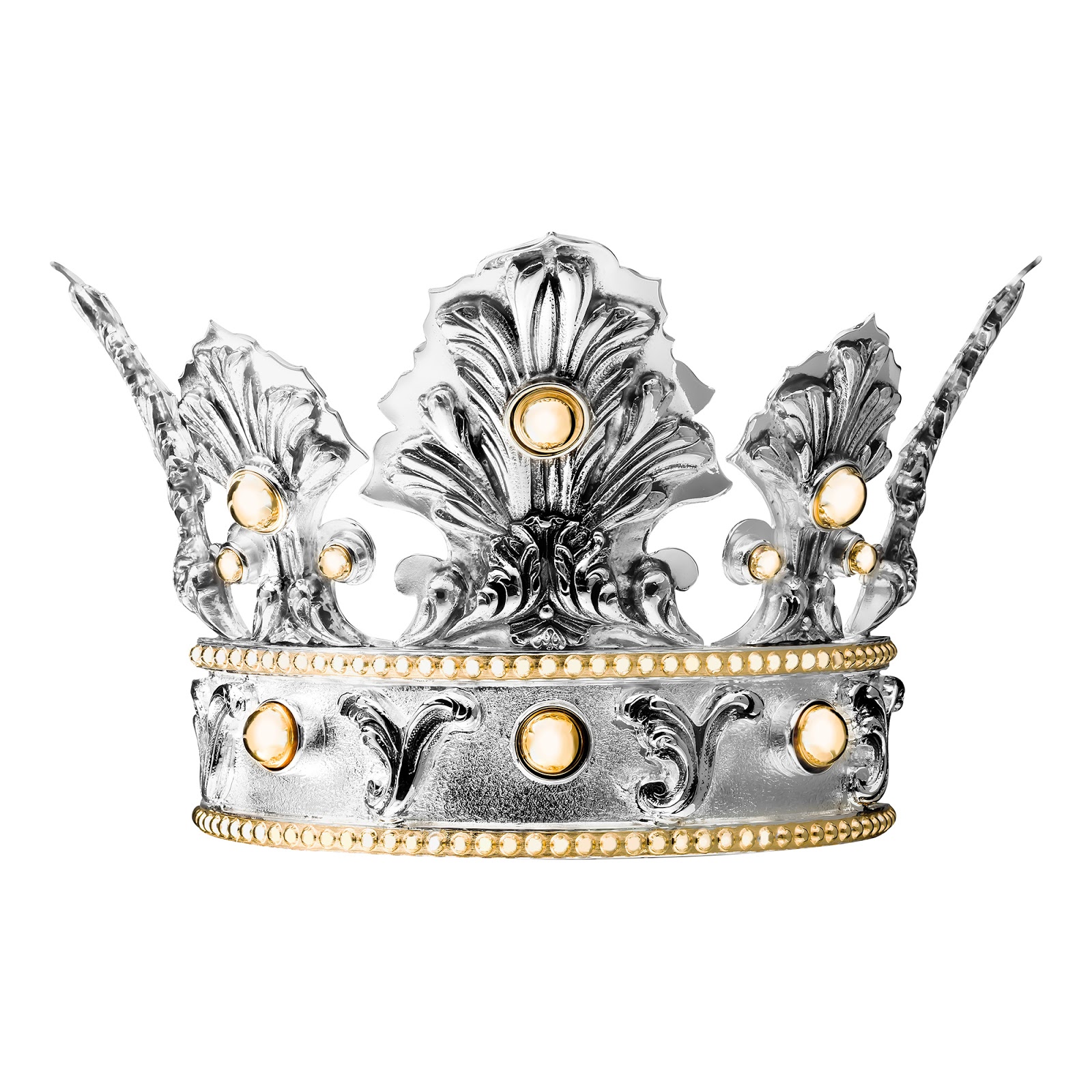
Sterling silver crown with black onyx accents

For anyone obsessed with royalty or if you just want to add a bit of royal flair in your life, you can now own a hand-crafted crown with much of the ornamental details that adorn traditional crowns historically worn by kings and queens. 

Christofle, the French luxury silver company, has teamed with Los Angeles-based interior designer Martyn Lawrence Bullard to produce two silver crowns. These crowns lack the priceless gems that adorn royal crowns. In addition, they are not meant to be worn. Instead, they are art objects to be displayed. But one can still dream. 

The collection of two crowns is called Silver Kingdom. Christofle built the crowns at its Haute Orfèvrerie atelier based on Bullard’s design. It is their debut collection together. For Christofle, it is part of a larger project in which the silver company teams with designers to create new pieces. 

Silver plated crown with gold accents

“I have always been fascinated with silver and its sensuous qualities, from the time I began collecting silver spoons as a child,” said Bullard, known for his A-List clientele as well as having his work appear in more than 4,000 publications around the world. “Silver Kingdom reflects my love of the materials and craftsmanship for which Christofle is renowned.”

Christofle said that despite the traditional theme, the collection is a reflection of its “modern spirit.” It was inspired by Christofle’s legacy as silversmith to France’s King Louis-Philippe and the House of Orléans. Bullard’s designs for the collection were influenced by the shape and form of the original French crown jewels. 

The collection features a large sterling silver crown produced in a numbered, limited-edition run of 20, customizable with embellishments and stones including onyx. It retails for $10,000. The second piece is a smaller silver-plated crown with gold accents, which retails for $2,500. Both objects can be customized and crafted to a buyer’s specification. 

Please join me on the Jewelry News Network Facebook Page, on Twitter @JewelryNewsNet and on the Forbes website.

Friday, October 17, 2014

‘Designing jewelry has been a passion of mine,’ Cocktails with JNN: Mayuri Vara of Vara of London

Smoky quartz is the main stone for the Fleur de Chine ring with black diamond pave center mounted on 925 sterling silver and lucky Chinese coin gallery on the back.

Every year that I go to Hong Kong to attend the September Hong Kong Jewellery & Gem Fair I discover something new. Last year, I attended a press conference at the Portuguese Heritage Club in the city’s Central district hosted by Qeelin, a luxury jewelry brand purchased by French luxury holding company, Kering. Afterward, I interviewed Dennis Chan, the creative director and co-founder of the brand. 

Taylor and Fleur de Chine Cuff uses gold plated textured 925 sterling with amethyst and pink tourmaline.

This year I found myself at the Gray Café Deluxe, on the 49th floor of the Upper House hotel, one of the city’s finest, with a spectacular view of the Kowloon skyline as it turned from day to night. This is where I met with Mayuri Vara, the founder of the new jewelry brand Vara of London, where she showed me her first jewelry collections over well-made martinis.

Bamboo Leaves ring uses chrome diopside for the leaves and 925 sterling silver.

Articulate and soft-spoken, the self-taught jewelry designer explains that the collections reflect her diverse heritage, experiences and personal influences. She is of Indian descent, raised in London and was on course to follow her father and brother’s footsteps in the medical profession before she veered off into more creative ambitions.

The upper part of the Diva drop earrings extend up the earlobe set with amethyst with with pink tourmaline. Lower hoop set with diamonds and amethyst center drop stone.

“I have always been fascinated by art and design, and designing jewelry has been a passion of mine,” she says, “having always made handmade jewelry as far back as I can remember.”

She has lived in Hong Kong for the past five years with her husband who is a lawyer. Her outside influences are equally diverse and include Elizabeth Taylor, Anna May Wong, the first Chinese-American movie star and a fashion icon, and Maharani Gayatri Devi, the last queen of Jaipur.

925 sterling silver is used for the Serpentine open bangle with smoky quartz and black diamond surround.

“I draw inspiration from the Chinese culture, artworks and architecture,” she adds. 

For someone with such a diverse background her first offerings are focused and for the most part classic and elegant. It’s a well thought out mix of products where individual pieces match but in a variety of ways so it doesn’t look like a formal suite. Most of the pieces are large and bold enough so they can be worn alone. They also are designed to be worn daily. 

The left side of Le Boteh open ring is set with smoky quartz with a black diamond centre; and the right side set with amethyst and pink tourmaline.

Nearly all of the pieces are made of 925 sterling silver plated with either gold, black rhodium, or white rhodium. She says her next line will be in 18k gold. She is particularly proud that the quality of craftsmanship, done in China, can be seen on both sides of the pieces. “I’m fortunate to find the right people who understand my flow,” she says.

The Cleopatra Noir ring features smoky quartz surrounded by two snakes and black diamond pave on head and tail with red garnet eyes. Black spinel surrounds body of the ring.

The black rhodium finishes add an edge to the classic styles. She also provides contrasts by using classic Lotus flower and paisley shapes with pieces that feature serpents. She is fond of colored gems, with smoky quartz, amethyst, citrine, peridot and tourmaline among her favorites. A few pieces have a sprinkling of diamonds.

The collections were launched in June during the Jewellery & Watch event at London’s Saatchi Gallery and are also available at the Quintessentially Gifts in London. 

Noor drop earrings uses 925 sterling silver set with Rose de France amethyst stones. The upper part is set with white topaz surrounding a single amethyst stone.

Please join me on the Jewelry News Network Facebook Page, on Twitter @JewelryNewsNet and on the Forbes website.

Friday, October 10, 2014

Creativity and Originality in Polish Jewelry Design

Amber and silver "Dragon" ring by Jacek Ostrowski

When a friend from the Polish jewelry industry told me during the recently concluded "Gold Silver and Time" tradeshow that the price of amber is comparable with the price of gold, I thought she was exaggerating. It turns out she was being conservative. Good rough amber sells for up to $60 a gram, about $20 per gram more than gold. 

Colorful cuffs by Marcin Zaremski

This came home to me when a woman working for Amber Apple, an amber and jewelry company, showed me a giant bracelet made entirely of rough amber. It was hard to me to believe it was a serious piece of jewelry for anyone other than Wilma Flintstone. I asked who would wear such a thing? The woman behind the counter said "A very large woman." It turns out she would also have to be a very rich woman as that bracelet was valued at more than $10,100. 

Rough amber bracelet by Amber Apple valed at more than $10,100.  Photo credit: Anthony DeMarco

The reason for this is none other than China, which seems to be sucking up the world’s natural resources (amber is fossilized tree resin) faster than the billions of years it took the earth to produce its bounty. The Chinese are buying rough amber, driving up the price to a ridiculous level, and using it to make inexpensive jewelry to sell to its own market. 

Pendant necklace made with layers of amber and driftwood by Marta Wlodarska of Amberwood 

Much of the amber in the US and other markets is used for inexpensive jewelry matched with silver. However, the escalation in its price has had a detrimental impact on this market. The result is that with rough amber costing more than gold, the Polish jewelry industry has turned to the creativity and originality of its top jewelry designers to distinguish itself in the international marketplace. Poland is the world’s second largest producer of silver jewelry and many of these designers primarily work with silver, gold and other metals.

3D necklace made of oxidized and gold-plated silver by Alicia Jakub Wyganowscy. Photo credit: Anthony DeMarco

At the tradeshow, several designers were featured in a special exhibit that coincided with the 25 year anniversary of Poland’s Solidarity movement. Tradeshow officials also dedicated about 60 exhibit spaces to these designers at a discounted price. That’s a significant number considering the tradeshow hosted a little more than 300 exhibitors.

Bracelet made with exotic wood, silver and gold by SzwedDesign

“The young people are creating jewelry that is interesting and different … very creative,” says Rafał Galimski, president of the MCT International Fair Centre, co-organizer of the trade fair. “We try to help them with the 60 stands.”

Amber and silver firefly resting on a piece of amber by Malgorzata Wasowska Jewellery Company

One of the selling points of Polish jewelry design (in addition to originality, design and craftsmanship) is value. The Polish currency, the Zolty, is worth about 25 percent of what the euro is worth. Poland is already an EU member and someday the country will adopt the European currency, although there is no timetable to do so. Once that happens, the cost of Polish jewelry will increase significantly. Collectors of modern jewelry may want to stock up on these pieces now. While acknowledging that adoption of the euro will be good for the country overall, Galimski says he isn’t looking forward to the increase in jewelry prices that will no doubt follow.

A yellow amber necklace by Marta Wlodarska of Amberwood. Photo credit: Anthony DeMarco

Poland’s largest jewelry markets for Polish designer jewelry are Germany, China, Italy and the US.

Many of the designs combine a modern aesthetic with a unique artistic perspective from being isolated from the rest of the world during the Soviet occupation. In fact, the approach of many of the designers is artistic rather than market driven.

Amber and silver necklace by Jacek Ostrowski. Photo credit: Anthony DeMarco

“Poland is a post-Soviet country,” said Warsaw-based Marcin Zaremski, the veteran of seven jewelry designers who presented their works to reporters. “We didn’t have the formal education, so we had a lot of artists that created jewelry. I think we developed in that direction very well.”

Coloful metal necklace by Marcin Zaremski

While speaking for Polish jewelry designers in general, Zaremski wasn’t necessarily speaking for himself. He did have a formal education, attending the Academy of Fine Arts in Warsaw with the intent of pursuing an interior design career. However, he chose to follow his parents lead and take up jewelry design but with a personal take. His jewelry and art objects are perhaps the most accessible of the group, creating pieces with all kinds of metals from gold and silver, to steel and copper.

A piece of Csarite, a gem known for changing colors, along with jewelry made from the gem exclusive to mines in the Anatolian mountains of Turkey by Novvak Jewellery. The same gem is also marketed as Zultanite. Photo credit: Anthony DeMarco

A younger designer whose is getting international attention is Jacek Ostrowski from the northern Polish city of Gdansk, the center of the country’s amber jewelry industry. He works with silver, colored acrylic, crystal Swarovski Elements, and of course, Baltic amber.

“My projects are dominated by the geometry of the shape,” he says. “I’m fascinated by the simplicity of form.”

More rough amber from Amber Apple. Photo credit: Anthony DeMarco

Meanwhile, Marta Wlodarska of Amberwood is a purist. As amber is fossilized tree resin, she chooses to create jewelry by pairing the material, sometimes in its natural state, with driftwood from the same beaches of the Baltic Sea where amber is found.

“I am fascinated by these two organic materials … the possibility to discover the things that have been hidden for millions of years,” she says. “Every piece of amber has its own story.”

However, she doesn’t shy away from using more exotic woods, such as African ebony, brick-red Padouk, and violet Amaranth.

There were plenty of traditional manufacturers working with silver, amber and other materials that were interesting as well. Among them was Novvak Jewellery, a Warsaw-based company working with a gem marketed under the name, Csarite, which comes from specific mines in the Anatolian mountains of Turkey. It’s unique to the remote area. The gem is known for its ability to change colors, from green to purplish-pink depending on the light. The same gem also is marketed under the name, “Zultanite,” which will no doubt be confusing to consumers. But it’s rare to be able to know the original of a gem without trusting the supply chain, which can be unreliable.

Please join me on the Jewelry News Network Facebook Page, on Twitter @JewelryNewsNet and on the Forbes website.

Friday, March 8, 2013

Georg Jensen Names David Chu as CEO

David Chu

Danish luxury silver brand and global retailer, Georg Jensen, said Friday it has appointed fashion designer and entrepreneur, David Chu, as its chief executive officer. Chu is well-known in the world of fashion for founding Nautica, the global lifestyle and clothing brand, in 1983 and turning it into a company with $1 billion in sales by the time he sold it in 2003 to Vanity Fair Corp.

Chu has been with Georg Jensen since November 2012, when the company was acquired by Investcorp. Chu was brought on as co-chair of Georg Jensen’s board of directors and chief creative officer. He will continue to serve as a board member as well as CCO to oversee the design direction and strategy for all products.

“My goal is to bring Georg Jensen to the design conscious community all over the world,” Chu said in a statement.

Among his many positions since selling Nautica, Chu served as chief creative officer of Tumi, the global luggage, travel and accessory brand.

Founded in 1904, Georg Jensen is known for its collaborations with leading artists and designers of the 20th century, including Henning Koppel, Johan Rohde and Arne Jacobsen, who are among the masters of 20th century modernism and Scandinavian design.

Please join me on the Jewelry News Network Facebook Page, on Twitter @JewelryNewsNet and on the Forbes Website.

Thursday, October 27, 2011

ATM Dispenses Diamond Jewelry, Gold and Silver

Bollywood star Raima Sen unveils Luxury ATM in Mumbai.

Why accept money from an ATM when you can get diamond jewelry, gold or silver?

A company in India has built what it says is the world’s first machine that dispenses gold, silver, diamond jewelry and religious jewelry.

The Gitanjali Group, the machine’s creator, is calling it an ATM, but I think a vending machine would also be an apt description. These types of machines have been vending gold at certain places around the world for the past few years. But this is the first such machine that also dispenses other precious metals and jewelry.

The first ATM was recently placed at a Mumbai shopping center and introduced with a ceremony featuring a Bollywood star Raima Sen (pictured).

The machine dispenses gold and silver bars, coins, pendants with religious motifs and a range of diamond-studded jewelry. The convenience of this machine will especially come in handy for those last-minute gifts, the company said.

“It has a particular significance in India, where usually such items are purchased as tokens to observe traditions on auspicious days,” Sanjeev Agarwal, CEO, Gitanjali Export Corp. Ltd., said in a statement. “But it also offers choices for occasions like Valentine’s Day, or to a husband who forgot an anniversary or his wife’s birthday”

The ATM uses a touch screen interface and provides consumers a mix of up to 36 options in different sizes, price points and designs across the precious metals and jewelry categories. This may include coins in various grams, pendants with religious motifs, and heart shaped pendants and diamond studded pendants. Prices range from about $20 to $610. Credit and debit cards are accepted.

The ATM is a part of a larger “Go for Gold” umbrella brand initiative created by Gitanjali to promote the purchase of gold—whether in the form of jewelry or coins/bars—and focus attention on the company’s gold products.

It is appropriate that it is the Gitanjali Group that is introducing this ATM concept. The Mumbai-based company is the world’s largest integrated branded diamond jewelry manufacturer. It is one of India’s largest manufacturer of diamonds and diamond and gold jewelry. It has close to 40 brands in several categories, including lifestyle, watches and 19 jewelry brands. Most of its brands use a Bollywood star for its advertising and marketing. Many of its brands are retailed through company-owned branded stores. The company recently acquired several Italian jewelry and watch manufacturers that it has incorporated into its branded marketing concept. It also owns retail chains in the U.S.

The ATM seems to be just one more creative way for the company to sell its many products.

Monday, August 23, 2010

North African ‘Desert Jewels’ Exhibit at Philadelphia Museum of Art


An exhibition of historic jewelry and photographs from North Africa will be on display at the Philadelphia Museum of Art in an exhibition called Desert Jewels, September 4 – December 5.

For thousands of years, North Africa, a region that comprises the modern nations of Algeria, Tunisia, Morocco, Libya and Egypt, has been a crossroads for trade and the transmission of cultural influences from the Middle East, sub-Saharan Africa and Europe. This exhibition explores the richly diverse artistic heritage of North Africa through the presentation of a group of extraordinary works of the jeweler’s art collected over the course of three decades by Xavier Guerrand-Hermès, of the Paris-based fashion empire. It includes 93 pieces of jewelry complemented by 28 late 19th- and early 20th-century images by photographers who were captivated by the allure of North Africa. The exhibit features ornate necklaces, bracelets, rings, and earrings, many of which have not been publicly displayed before this exhibition.

The exhibit will be in the new Ruth and Raymond G. Perelman Building, across the street from the main museum building.

“These objects illuminate the rich history of North African craftsmanship, which has been shaped by the imprint of many different cultural traditions,” said Timothy Rub, the Philadelphia Museum of Art’s George D. Widener director and CEO. “We are pleased to collaborate with the Museum for African Art to share this exceptional collection, which is remarkable not only for its quality and great beauty, but also for the rich insights it provides into the customs and cultural diversity of North Africa.”

Examples of jewelry created with combinations of silver, coral, amber, coins, and semi-precious stones demonstrate the shared aesthetic heritage of many North African societies, the Philadelphia Museum said in a statement. Meanwhile, variations in materials and motifs reflect significant regional differences. Brightly colored necklaces of amazonite beads or large amber beads, such as the Three-Strand Necklace made in Morocco, symbolize wealth, while pendants or enameled beads known as tagguemout are used to encourage the wearer’s fertility. Many of the works in the exhibition indicate regional and group identity, and many were designed to protect the wearer from harm. Hand-shaped amulets, or Khamsa, typically made of silver, are the most popular form of protective jewelry, and are sometimes engraved with prayers and inscriptions in Arabic and Hebrew. The jewelry on view also identifies its wearer. Women receive jewelry from their husbands when they marry and wear it as a symbolic expression of social codes and cultural identity. Some of the jewelry on view is unique to a specific geographic location.

Beginning in the 1860s, European photographers seeking images of foreign locales, set up studios in the major cities of North Africa, photographing women wearing their jewels, as well as documenting markets, ancient archaeological sites and landscapes. The popularity of these photographs, which featured images of Arabs, Jews, Imazighen (also known as Berbers) and people from sub-Saharan Africa, reflected Europeans’ growing fascination with the so-called Orient.

These photographs came to the attention of Western collectors in the 19th century, when archaeological monuments in the region were being explored, visited, and, in some cases, pillaged. Important photographers of the day including the Scotsman George Washington Wilson, the Neurdine brothers from France, and the Turkish photographer Pascal Sabah, visited the region. Some of their images were used for postcards, while other remained in little-known collections.

Captions: (Top) Necklace with central pendant, Tagguemout, 20th Century, Draa Valley, Morocco, Silver, coral, enamel, coins, glass, copal, shell, cotton, plastic, buttons, Photo courtesy of Karen L. Willis/Museum for African Art.

(Second image) Hand pendant with salamander motif, Khamsa 19th or 20th Century, MoroccoSilver, bronze.

Friday, June 25, 2010

Light, Durable Silver and Gold Jewelry from Calgaro


Combining the art and techniques of gold jewelry making and textile design has been the cornerstone of the fine jewelry creations of Calgaro, based in Vicenza, Italy.

Goldsmith Giuseppe Calgaro and textile designer Monica Fin first began working together in 2000 as technological advancements in gold and jewelry manufacturing met their vision of creating elegant, woven, fabric-like gold and silver jewelry designs. They formed the company, Calgaro, three years later. In January, the company merged with Italian gold and silver fashion jewelry designer Rosato, but will continue to produce its own designs under its brand. Among their design innovations are the development of gold crochet (pictured left) and dying silver thread in many bold, vibrant colors.

During the Couture Show at the Wynn Hotel in Las Vegas, held early June, they released their latest collections for the U.S. market, including “Jealousy,” (pictured above and left) and Asia.

In Jealousy, silver colored wire has the appearance and feel of soft fabric while retaining its strength and elasticity. The creators call it a “long-lasting embrace, an embrace of love, of passion.”

In Asia (below), inspiration was taken from the orient as the “hypnotic appeal of this land becomes a story carved on the surface of these jewels.” And again technology is employed as laser drawings to create silk-like embroideries.

The collection includes long necklaces, bracelets, rings and earrings. Again there’s contrast. On one hand the precious metal is in its natural color, in a shine black or in a particular shade of rose. On the other hand the silver turns into a myriad of fine threads, feather-light, yet tough.

Tuesday, June 8, 2010

New Collections from Rosato


Rosato Jewelry was one of the busier Italian companies during jewelry week in Las Vegas. They launched several new collections and judging from the activity at their booths throughout the week I’d say you will be seeing plenty of their designs for the fall and holiday seasons.
Among the new lines from the company, known for its silver and enamel charms, has partner with the creators of the new movie Letters to Juliet, to create silver love letter charm pendant. The new piece features a .925 sterling silver envelope engraved with “Love Is…” linked by a short chain to a sterling silver love letter reading a selection of four messages: “What If, Forever,” “Ti Ador” (“I adore you”) or “Love is Family.” It is now available exclusively at Bloomingdale’s stores where it retails for $95.


The company, based in Arezzo and Milan, also introduced a canine-inspired line called “My Dog Collection.” It features necklaces, bracelets and pendants adorned with enamel charms decorated with the faces of popular dog breeds. Again the line is available at Bloomingdale’s and fine retail stores in the United States, with retail prices ranging from $195 to $495.

Rosato introduced three new lines: “Bouquet,” “Aphrodite” and “Peace & Love,” for the upcoming seasons.

The Bouquet collection (pictured at the top) consists of a line of black and white flowers made into silver necklaces, earrings and rings with prices starting at $485.

Aphrodite is a colorful collection of silver bangles, rings and earrings that range from $75 to $295.


The Peace and Love collection of pendants and necklaces are inscribed with the words “Peace” and/or “Love” on circular silver pieces in a number of different designs. Prices range from $150 to $475.

Rosato was founded in 2004 by Simona Rosato, its creative director, with the idea of turning fine jewelry into a more trend-driven accessory.