Asteria Colored Diamonds

Asteria Colored Diamonds

TechForm

TechForm Platinum Jewelry Casting

Leibish & Co

Thursday, November 13, 2014

Q3 Global Gold Jewelry Demand Down 4%, US Demand Up 4%; India Demand Surges 60%


Global gold jewelry demand fell 4 percent year-over-year to 534.2 tons for the third quarter of 2014, according to the World Gold Council in its Gold Demand trend report released Thursday. However, the decline comes against an unusually robust third quarter of 2013, which experienced the strongest growth for jewelry demand since 2008. 

“Longer term analysis shows a market in good health. Q3 demand was marginally stronger than the five-year quarterly average of 527.6 tons, while year-to-date volumes continue to extend the broad uptrend from the low seen in 2009,” the WGC said in its report.

Two markets did shine, the US, with a 4 percent rise that helped lift manufacturing outputs in several gold jewelry producing countries; and India, which surged 60 percent. China and Hong Kong, meanwhile, experienced steep declines in gold jewelry demand. 

US ‘Revival’
The WGC’s report said the economic recovery and a downward trend in the price of gold created a “revival” of gold jewelry demand in the US that has had a “ripple effect” around the world.

“The US sucked in greater volumes of gold jewelry imports from markets as diverse as India, China, Italy, Mexico and Oman, according to the report. “Third quarter growth in the US market was very much an extension of the trend that has prevailed since early last year. Mounting conviction in the economic recovery has boosted sentiment and whetted consumers’ appetite for discretionary purchases. Gold jewelry has been a clear beneficiary: improving sales of higher carat and non-wedding related items helped demand to the highest Q3 total since 2009.”

The report added, “Lower gold prices have aided the recovery of US demand as retailers are more easily able to meet key price points without crimping margins. Or, similarly, to increase karatage while maintaining price levels. This has enticed some mass- market retailers back into the gold jewelry sector.”

India
The market that had the strongest third quarter by far was India, which reported a 60 percent year-over-year increase to nearly 183 tons—the second highest third quarter on record, the WGC said. 

“The third quarter of 2013 was decidedly weak as the introduction of complicated new measures to restrict gold imports and the subsequent sharp rise in local prices knocked demand,” the WGC said in its report. “But this quarter, other more positive forces were also at play.”

Among those forces is the confidence in the new Indian government led by Prime Minister Narendra Modi, a drop in the price of gold and robust buying during the Diwali festival season. 

“Although Indian consumers are typically wary of buying gold while the price is still moving, preferring to wait until it settles at a more stable level, the opportunity to buy at cheaper prices proved, for some, hard to resist.”

China
Meanwhile, China experienced a 39 percent year-over-year decline to 147.1 tons in gold jewelry demand. Hong Kong (where consumers from the mainland China account for most of the demand) fell 31 percent to 9 tons. The WGC said much of this decline is in comparison to the rapid expansion throughout 2013 and that gold jewelry sales are normalizing.

“18-karat (K-gold) jewelry was relatively more robust than the 24-karat (chuk kam) segment,” the WGC said. “The government’s anti-corruption drive may have contributed to this trend.”

Other Markets:
* Indonesia saw third quarter demand fall 16 percent to 9.7 tons partially in response to strength of demand last year. However, the WGC said “equally important was the Presidential election in July, which created a degree of political instability and discouraged spending on gold jewelry.” 

* Third quarter jewelry demand in Turkey fell 18 percent, year-over-year, to 19.2 tons—the lowest third quarter on record, the WGC said. “Consumers were unnerved by domestic political turmoil; worrying economic signals; and escalating Syrian violence in close proximity to the Turkish border. The ban on paying for gold jewelry by credit card installments continued to hang over the market, although this restriction was partially repealed in October.”

* Demand in the Middle East fell 14 percent year-over-year to 36 tons. Demand for gold jewelry across the region suffered from the comparison with strong demand last year, the WGC said, leading to a trend towards lower-karat and gem-set jewelry.

* Jewelry demand in the UK increased 18 percent to 4.6 tons, the fifth consecutive year-over-year rise.

* Gold jewelry demand in Russia edged up 1 percent year-over-year to 18.6 tons, despite a rise in the average domestic gold price due to a weaker rouble, the WGC said. 

* Demand in Italy fell 4 percent year-over-year to 2.7 tons. 

The Gold Demand Trends report also tracks gold for investment and technology purposes. In the third quarter overall demand was “subdued,’ the WGC said, falling by 2 percent to 929.3 tons. The price was relatively stable for the period. 

“Quarterly volatility in the US$ gold price was among the lowest levels seen over the past two decades,” WGC said. “This was both a cause and effect of the benign demand environment. Investor behavior in particular contributed to this circularity: the lack of a clear price signal caused investors to hold back from buying gold, which in turn dampened down price moves.”

Please join me on the Jewelry News Network Facebook Page, on Twitter @JewelryNewsNet and on the Forbes website.

Tuesday, November 11, 2014

‘Blue Belle of Asia’ Sapphire Fetches World Auction Record $17.3 Million

Blue Belle of Asia

A 392.52-carat cushion shaped Ceylon sapphire sold for nearly $17.3 million at Christie’s Geneva sale of Magnificent jewels Tuesday—a world record for any sapphire sold at auction. Known as the 'Blue Belle of Asia,' the gem shattered its high estimate of $10 million. 

The gem, considered the world’s fourth largest faceted sapphire, was discovered in 1926 at Pelmadula, Ratnapura (‘The City of Gems’), in Ceylon and was sold to British motor magnate Lord Nuffield (1877-1963), according to the auction house. It was rumored that he purchased the sapphire to present it to Queen Elizabeth the Queen Mother, on her Coronation Day. The gem is suspended on a diamond tassel pendant and attached to a diamond neckchain mounted in gold.

It was one of several big ticket items at the auction, which achieved more than $150.2 million, with 89 percent sold by lot and 94 percent sold by value. Christie’s said it was “the highest total for any Magnificent Jewels sale in the world.” 

Fancy colored diamond ear pendants

World renowned diamond jeweler, Laurence Graff, acquired a pair of ear pendants, featuring a 6.95-carat, pear-shaped fancy vivid blue diamond, and a 6.79-carat, pear-shaped fancy vivid pink diamond, for more than $15.8 million. Previously known as “A Bulgari Masterpiece,” the fancy colored diamonds are topped with marquise and pear-shaped diamond clusters weighing approximately 19.28 carats. The high estimate for the item was $15 million.

Empress Eugenie’s Feuilles De Groseillier Brooch

One of the more anticipated lots was the “Feuilles de Groseillier” brooch, commissioned in 1855 by Empress Eugenie of France (1826-1920) to French jeweler Alfred Bapst. It was part of the French Crown Jewels. It sold for more than $2.3 million, within its estimate of $2 to $3 million.

Christie’s said more than 600 persons from 30 countries registered for the auction.

Other notable sales included the JAR “Parrot Tulip” bangle bracelet that realized more than $3.5 million, nearly ten times its estimate and the second highest price for a creation by JAR; and an Art Deco natural pearl and diamond necklace from the private collection of the Baroness Edouard de Rothschild that sold for nearly $5.2 million.

Please join me on the Jewelry News Network Facebook Page, on Twitter @JewelryNewsNet and on the Forbes website.

The 2015 AGTA Spectrum Awards Winners

Best of Show, Leon Mege - Platinum ring with a 4.71 ct. Paraiba tourmaline accented with French-cut diamonds.

The AGTA Spectrum Awards media day and winners announcement were held recently at its usual undisclosed New York location. I was unable to attend the event this year but that doesn’t mean you have to be neglected of at least seeing the top category winners. 

Best Use of Color, Paula Crevoshay – 18k yellow gold "The Venus Bracelet" with freshwater baroque cultured Pearls (91.43 ctw.) accented with pink and green tourmalines (29.32 ctw.).

The Spectrum Awards are considered by many to be the most respected and prestigious creative awards for the jewelry design industry. Launched in 1984 by the American Gem Trade Association, it honors, recognizes and promotes designers whose work uses natural colored gemstones and cultured pearls in finished fine jewelry design. The international competition serves as the benchmark for jewelry designers striving to gain recognition for their work. In addition, it is one of things the jewelry industry establishes trends through the use of color and materials. 

Best Use of Platinum and Color, Deirdre Featherstone - Platinum "Anemone" earrings with tanzanites (5.37 ctw.) accented with blue zircons (2.88 ctw.), purple sapphires (3.72 ctw.), tsavorite garnets (1.67 ctw.), indigo tourmalines (.40 ctw.), Paraiba tourmalines (.26 ctw.) and Diamonds (.16 ctw.).  

Douglas K. Hucker, CEO of the AGTA, says the 500 or designers who participated in the competition stretched the boundaries in what can be achieved in jewelry design with colored gems and pearls. 

Best Use of Pearls, Naomi Sarna – 18k rose gold necklace with white cultured pearls accented with pink diamonds.

“We were thrilled with the variety of entries at this year’s awards competition,” he said. “We saw a lot of use of striking and strong colors instead of pastels. There were asymmetrical pieces combining rounds with ovals and squares.” 

Evening Wear Maria Canale, Suna Bros. Inc. - Platinum and 20k pink gold bracelet with multi-colored natural spinels (44.31 ctw.) accented with white diamonds (6.80 ctw.) and pink diamonds (1.00 ctw.).

Among the popular choice for colors were blue, and blue green; and the most popular gems used for the competition were tourmalines, sapphires and opals, he added. In addition, he noted that there was a three-fold increase to the entries to the men’s wear category.

Fashion Forward, Ion Ionescu – 18k yellow gold ring featuring a 36 ct. turquoise accented with a 9.2mm Tahitian silver cultured pearl, Paraiba tourmalines (.32 ctw.) and diamonds (.43 ctw.).

Judging from the top winners at the show, pearls and the extremely rare Paraiba tourmaline were used quite extensively.

Business/Day Wear, Jennifer Rabe Morin, Gregore Joailliers – 18k rose gold ring with carved turquoise (29.0 ctw.) accented with amethyst cabochons (14.0 ctw.).

This year's AGTA Spectrum Awards will be presented during the 2015 AGTA GemFair Tucson to be held February 3 - 8 (a trade only event) at the Tucson Convention Center in Tucson, Ariz., with the winning entries will be displayed during the show.

Men's Wear, Dawn Muscio – 18k red gold and stainless steel "Pink2" cufflinks featuring pillow cut Morganites (8.74 ctw.) accented with Rubies (.87 ctw.) and Diamonds (.60 ctw.).

Please join me on the Jewelry News Network Facebook Page, on Twitter @JewelryNewsNet and on the Forbes website.


Henry Graves Supercomplication Fetches $24 Million at Sotheby’s Geneva


With all the superlatives attached to it, it was a near certainty that The Henry Graves Supercomplication would go for a world record price at Sotheby’s Geneva sale of Important Watches held Tuesday. It already established the record when it sold for $11 million in 1999. It is also known as the most complicated hand-made watch and the most famous watch in the world.

But still the $24 million it achieved is something special. The auction house said five bidders competed for the timepiece for 15 minutes. It was finally sold to a buyer in the room, who requested anonymity, well above its $16.8 million estimate.

“This evening’s stellar result confirms the ‘rockstar’ status of The Henry Graves Supercomplication. It is more than a watch,” said Tim Bourne, Sotheby’s Worldwide Head of Watches, and Daryn Schnipper, Chairman of Sotheby’s Watch Division. “It is a masterpiece that transcends the boundaries of horology and has earned its place among the world’s greatest works of art. The fascination it has attracted over the past few months, as Patek Philippe celebrates its 175th anniversary, is a fitting tribute to the genius of the Swiss manufacturer.”

Commissioned in 1925 by Henry Graves, a prominent New York banker, and completed by Patek Philippe in 1932, The Henry Graves Supercomplication is the product of three years of research and five years of effort it resulted in a gold openface minute repeating chronograph clockwatch with Westminster chimes. Among its features are a perpetual calendar, moon phases, sidereal time, power reserve, and indications for time of sunset and sunrise and the night sky of New York City. With a total of 24 horological complications, The Graves watch retained the title of the world’s most complicated watch for 56 years and even then was only surpassed by technicians working with the aid of computer-assisted machines.

Please join me on the Jewelry News Network Facebook Page, on Twitter @JewelryNewsNet and on the Forbes website.

Thursday, November 6, 2014

The internet's Impact on the ‘Makers’ and ‘Takers’ in the Global Jewelry Industry


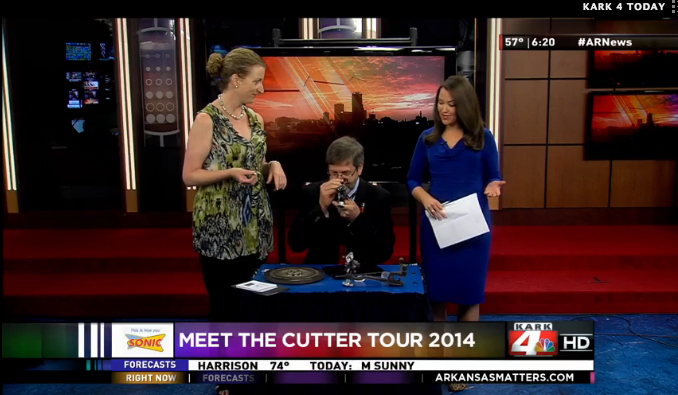
Laura Stanley of Stanley Jewelers Gemologist, Little Rock, Ark., hosted Master Diamond Cutter Mike Botha of Embee Diamonds to teach consumers about the diamond cutting process. The event was televised on a local news station.
This is the first in a series of articles by Chris Benham, co-founder and director of Inspired Jewellery Ltd., Wellington, New Zealand, a global creative studio for specialist jewelry design.  

The internet has had a hugely disruptive effect on the jewelry industry in recent years, as it has with most industries. Our rapidly shrinking world has led to an increase in transparency, access and an explosion of product choice. The side effect of this is that many traditional jewelry businesses throughout the value chain have seen their margins erode.

A lot of traditional "taker" businesses that, in the past, have had to accept the prices of their suppliers, and who have historically been able to set their own prices with little challenge from their end customers, now cannot. These taker businesses range from local diamond wholesalers to Mom-and-Pop jewelry retailers that have been around for generations. Customers can quickly jump on the internet to compare prices, so these businesses have had to find ways to survive by adding value to their end customers. 

The companies that have thrived in recent years are the "makers" - the ones that have taken tradition and redefined it. There are many great examples of companies that have built brands that focus on design, craftsmanship, great personal service and trust. The byproduct of doing the tangibles well are the intangibles that form the basis of their innovation and ultimately the intellectual property that other companies struggle to understand or replicate.

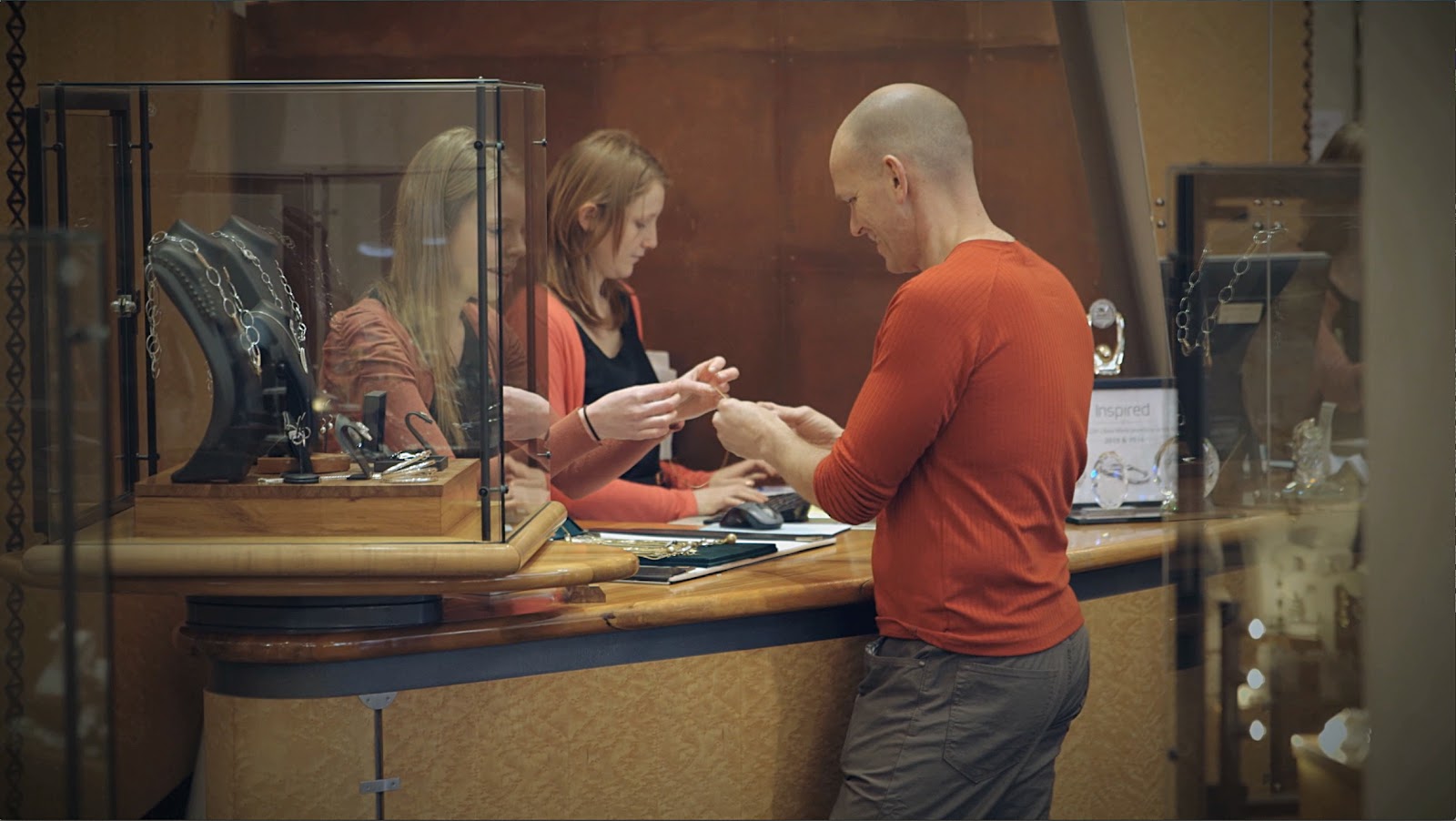
Customer picking up his purchase at The Village Goldsmith, Wellington NZ. 

The internet breeds monopolies and no more so than in the jewelry industry. The top tier diamond companies are becoming more and more dominant by the day, helped by natural economies of scale and their purchasing power. Much of the reason for this is that ‘Mom and Pop’ retailers from the US to New Zealand have the same access to diamond inventory lists as do the major online global jewelry retailers. Consumers are able to access diamond pricing information and descriptions instantaneously, make comparisons and choices at the touch of a button, and this has led to the erosion of traditional margins for retailers. Diamond companies’ margins are also getting tighter as they fight to remain competitive, ensuring that they need to innovate to stay relevant.

Why is this good for the end customer? Well, it forces companies throughout the whole value chain in the jewelry industry to genuinely look at clever ways to create better products and experiences for their customers.


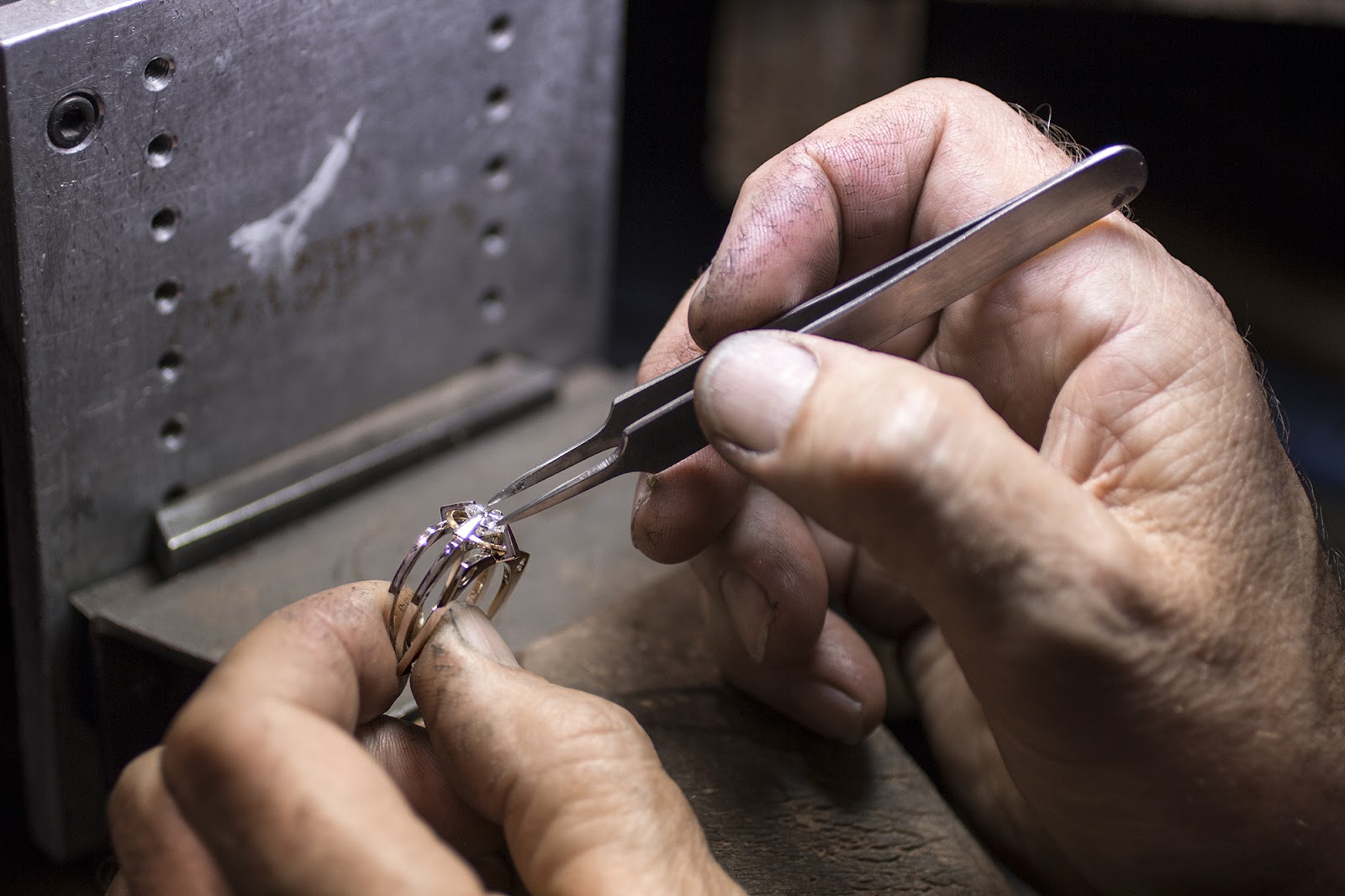
A master jeweler at Inspired Jewellery sets a diamond on a ring. 

Retailers big and small that continue to focus their efforts around the needs of their customers are seeing strong growth. In a recent report big retailers like Nordstrom attribute customer service as central to their strategy and recent growth. They are using different store types and brands to appeal to different customer profiles and age groups. They’ve recognized the need to connect with the younger generation as they will be tomorrow’s customer and are using an omni-channel strategy to support this. Burberry is another luxury brand that is going to great lengths to connect the retail store experience with the online experience.

Recent research conducted by Bain and Co. stated that when consumers were selecting which jewelry store to buy from in Western markets they valued quality service over all other factors. 

A local US retailer that has recognized this is Stanley Jewelers Gemologist in Little Rock Arkansas. Vice President Laura Stanley recently hosted Master Diamond Cutter Mike Botha of Embee Diamonds (see top photo). The aim of the “Southern Stars: Meet the Cutter” tour was to teach consumers about the diamond cutting process so that they are able to make more informed decisions. Laura Stanley said that the theme of the event was to get to know your jeweler better. The event provided Stanley’s customers with an authentic experience of what goes into cutting a diamond - a craft that is not often showcased to consumers. 

If “price makers” want to retain that position they must continually innovate and provide more intangibles for their customers to prove that the price they set is worth paying.

Please join me on the Jewelry News Network Facebook Page, on Twitter @JewelryNewsNet and on the Forbes website.

Tuesday, November 4, 2014

Jewelry From Empress Eugenie and Duchess of Windsor Headlines Christie’s Geneva Sale

Empress Eugenie's Feuilles De Groseillier brooch

The “Feuilles de Groseillier” brooch, commissioned in 1855 by Empress Eugenie of France (1826-1920) to French jeweler Alfred Bapst, is one of two statement lots of jewelry with royal provenance to be offered at Christie’s Geneva Magnificent Jewels sale on November 11. Once part of the French Crown Jewels, of which very few examples in original condition have survived, it has an estimate of $2 to $3 million.

The jewel is designed as a cluster of three gold and silver openworked currant leaves with three tassels. It is set throughout with old mine diamonds and is centered with a cushion-shaped mine diamond.

The Parure de Feuilles de Groseillier was originally designed as a guirlande (garland) and worn in multiple ways. In 1870, at the fall of the Second Empire, Empress Eugenie and her husband Napoleon III moved to England, leaving behind most of the Crown Jewels. Seventeen years later, the French government conducted a 12-day auction where all the belongings of the French Royal Family were offered for sale, including the jewelry. Several of the larger pieces were broken up prior to the auction so the stones could be sold individually. The guirlande was sold as eight parts and the present brooch was acquired by Tiffany & Co. The jeweler then gifted the brooch to the Metropolitan Opera of New York as a tribute to the famous opera singer Madame Lucrezia Bori (1887-1960).

Duchess Of Windsor's Cartier Tiger jewels

The other lot is of British royal provenance. They are two pieces of tiger jewelry by Cartier, formerly from the collection of the Duchess of Windsor. They were given to Sarah Brightman, the world’s best selling soprano, by her then husband Andrew Lloyd Webber, composer and impresario of musical theater. They were a present to her to celebrate the London and Broadway success of “The Phantom of the Opera,” which he wrote and she starred. They were purchased during the legendary sale of Duchess of Windsor’s collection in 1987.

The two tiger pieces comprising of an onyx and diamond clip brooch and bracelet, with emerald eyes, were both made in the 1950s and will be sold as one lot with a combined estimate of $1.8 million to $2.5 million.

The Cartier Tiger Collection has been a highlight of 20th Century jewelry design since it first appeared in 1928. These pieces were bought by the Duke and Duchess of Windsor from Cartier between 1956 and 1959.

Brightman will offer a portion of the proceeds from the sale to The Andrew Lloyd Webber Foundation, which supports the arts, music in schools, The Architectural Heritage Fund and awards 30 performing arts scholarships annually.

Bulgari diamond ear pendant

While the two items of monarchial heritage are impressive, the top lot for the upcoming sale at the Four Seasons Hotel des Bergues goes to a sparkling pair of Bulgari pear-shaped colored diamond ear-pendants with a pre-sale estimate of $12 million to $15 million.

The ear pendants, which the auction house is calling “A Bulgari Masterpiece,” have marquise and pear-shaped diamond cluster tops weighing approximately 19.28 carats. Suspended from the clusters are a 6.95-carat, pear-shaped fancy vivid blue diamond and a 6.79-carat, pear-shaped fancy vivid pink diamond. Both statement diamonds are detachable. The diamonds are mounted in platinum and gold.

This auction of 390 lots has several other significant colored gems, signature jewels and important natural pearls. Among them are:

The "Blue Belle of Asia"

* The fourth largest faceted sapphire in the world, the “Blue Belle of Asia,” a cushion shaped Ceylon sapphire of 392.52 carats. It has an estimate of $7 to $10 million. The gem was discovered in 1926 at Pelmadula, Ratnapura (‘The City of Gems’), in Ceylon and was sold to British motor magnate Lord Nuffield (1877-1963), founder of Morris Motors Limited in 1937, according to the auction house. It was rumored that he purchased the sapphire to present to Queen Elizabeth the Queen Mother, on her Coronation Day on May 12, 1937. The gem is suspended on a diamond tassel pendant and attached to a diamond neckchain mounted in gold.

* A 23.66-carat Burmese ruby mounted by Cartier, known as “The Queen of Burma,” was purchased at Cartier in London on November 1937 by the Maharao of Cutch (1866-1942). Its estimate is $5.5 - $7 million. The auction house says the gem “combines all the most sought-after qualities in a ruby: an attractive vivid pinkish red color, an excellent purity, an impressive size and the finest origin.”

* Seven jewels by JAR, some of which were recently on display at the ‘Jewels by JAR’ exhibition at the Metropolitan Museum of Art in New York. Among the group of jewels offered for sale are the ‘Gardenia’ ring, formerly in The Collection of Ellen Barkin ($330,000 - $390,000), the sculpted gold Parrot Tulip cuff ($210,000 - $310,000) and a pair of diamond ‘String’ ear pendants ($140,000 - $200,000).
Art Deco diamond and pearl necklace

* Formerly in the collection of Baroness Edouard de Rothschild, an Art Deco diamond necklace, suspended with two natural pearls, measuring 16mm each ($700,000 - $1 million).

Harry Winston diamond ear pendants.

* Diamond ear pendants by Harry Winston with two drop-shaped natural pearls weighing more than 100 grains each ($2.8 - $3.5 million).

* A two-strand natural pearl necklace with rose overtones by Cartier ($530,000 - $850,000).

Please join me on the Jewelry News Network Facebook Page, on Twitter @JewelryNewsNet and on the Forbes website.

Monday, November 3, 2014

‘Graff Ruby’ Leads Esteemed Jewelry Collection For Sale at Sotheby’s


The 8.62-carat “Graff Ruby,” is the lead item in a collection of 16 jewels belonging to Dimitri Mavrommatis that is part of Sotheby’s Geneva November 12 Magnificent Jewels and Noble Jewels sale.  The cushion-shaped Burmese stone is estimated to fetch 6.9 million to nearly 9.2 million. 

The gem possesses the rare vivid red hue known as “pigeon’s blood,” according to a report from the Swiss Gemmological Institute, and is also of outstanding purity and superb brilliance.

Dimitri Mavrommatis began a lifelong interest in the fine and decorative arts in 1982 during trips to the Metropolitan Museum of Art. The 16 jewelry and gem pieces from his personal collection to be placed on auction at the Beau-Rivage Hotel is expected to bring in more than $17.6 million.

David Bennett, chairman of Sotheby’s Jewellery Division for Europe and the Middle East, said the collection “is a testament to Dimitri Mavrommatis’ discerning eye and impeccable taste.”


Another item of from the Mavrommatis collection is a 27.54-carat Kashmir sapphire (pictured above) to fetch $3 million to $6.1 million. The stone exhibits a saturated velvety blue color, combined with a very high purity, according to the auction house. “These features elevate Kashmir sapphires above all others and the appearance of such a fine example weighing over 20 carats is an extremely rare event.”

Please join me on the Jewelry News Network Facebook Page, on Twitter @JewelryNewsNet and on the Forbes website.